
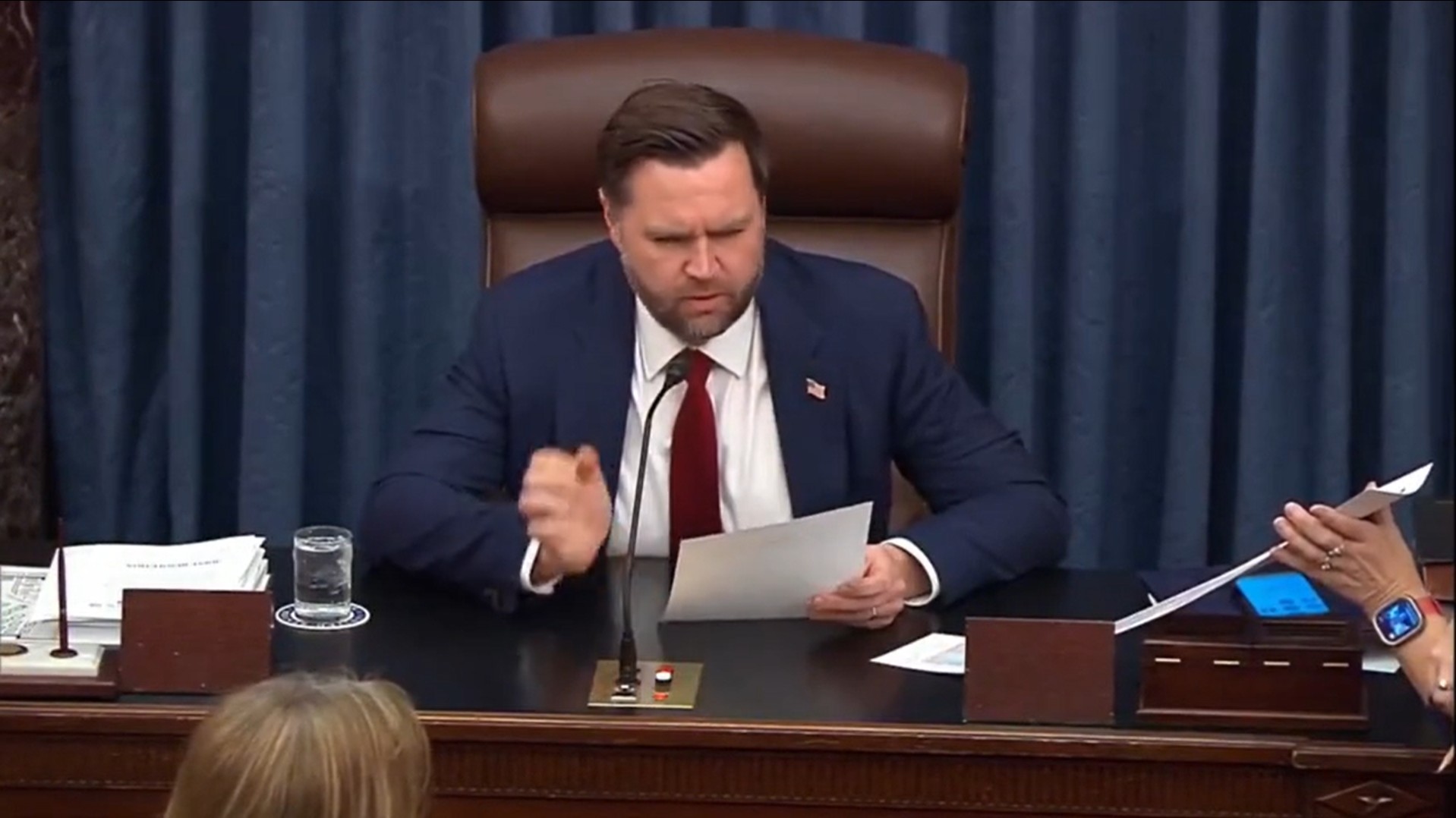

The U.S. Senate has just dealt President Trump a big legislative victory by defeating a controversial war powers resolution that would have limited his ability to conduct military actions in Venezuela without congressional approval. After a dramatic session on Capitol Hill Wednesday evening, the Senate voted 51-50 to dismiss the measure, with Vice President JD Vance stepping in to cast the deciding vote and block further consideration of the bill.
The resolution, introduced by Democratic Senator Tim Kaine of Virginia, sought to rein in presidential authority by requiring Congress to approve future hostilities in or against Venezuela. It came on the heels of the U.S. military’s January 3 operation that resulted in the capture of Venezuelan leader Nicolás Maduro, an action that intensified debate over executive war powers.
Initially the measure appeared to have significant momentum. Last week the Senate voted 52-47 to advance it for debate, with five Republican senators joining every Senate Democrat to move it forward. But that fragile bipartisan coalition fell apart Wednesday when two GOP senators who initially supported the resolution, Josh Hawley of Missouri and Todd Young of Indiana, reversed their positions under pressure from the White House and GOP leadership. Their switch deprived the resolution of the votes needed for final passage, setting up the 50-50 tie that forced Vance to intervene.
President Trump had spent the past week applying intense pressure on Republican senators who broke ranks, publicly criticizing them and making private calls to urge them to withdraw their support. Trump’s efforts appeared to succeed with Hawley and Young, who cited assurances from administration officials, including Secretary of State Marco Rubio, that no U.S. ground troops are currently or would be deployed in Venezuela and that any future major military operations would involve consultation with Congress.
Three other Republicans who voted with Democrats to advance the resolution — Sen. Rand Paul of Kentucky, Sen. Lisa Murkowski of Alaska, and Sen. Susan Collins of Maine — stood by their support for the bill on Wednesday, but it wasn’t enough to secure its passage.
The razor-thin margin underscored both Trump’s continued sway over much of the Republican conference and the underlying unease among some lawmakers regarding his expansive foreign policy ambitions. Critics of the resolution argued that there are currently no U.S. troops engaged in active “hostilities” in Venezuela, making the bill unnecessary, and they emphasized the need for the president to retain flexibility to protect American interests.
Supporters of the measure, particularly Senate Democrats, saw its defeat as a missed opportunity for Congress to reclaim its constitutional authority over declarations of war, and they pledged to continue efforts to challenge Trump’s use of military power.
For now, the failed resolution represents a significant tactical win for the White House, as it maintains the status quo on presidential war authority and highlights the political leverage Trump still holds within his party.
Leave a Comment