
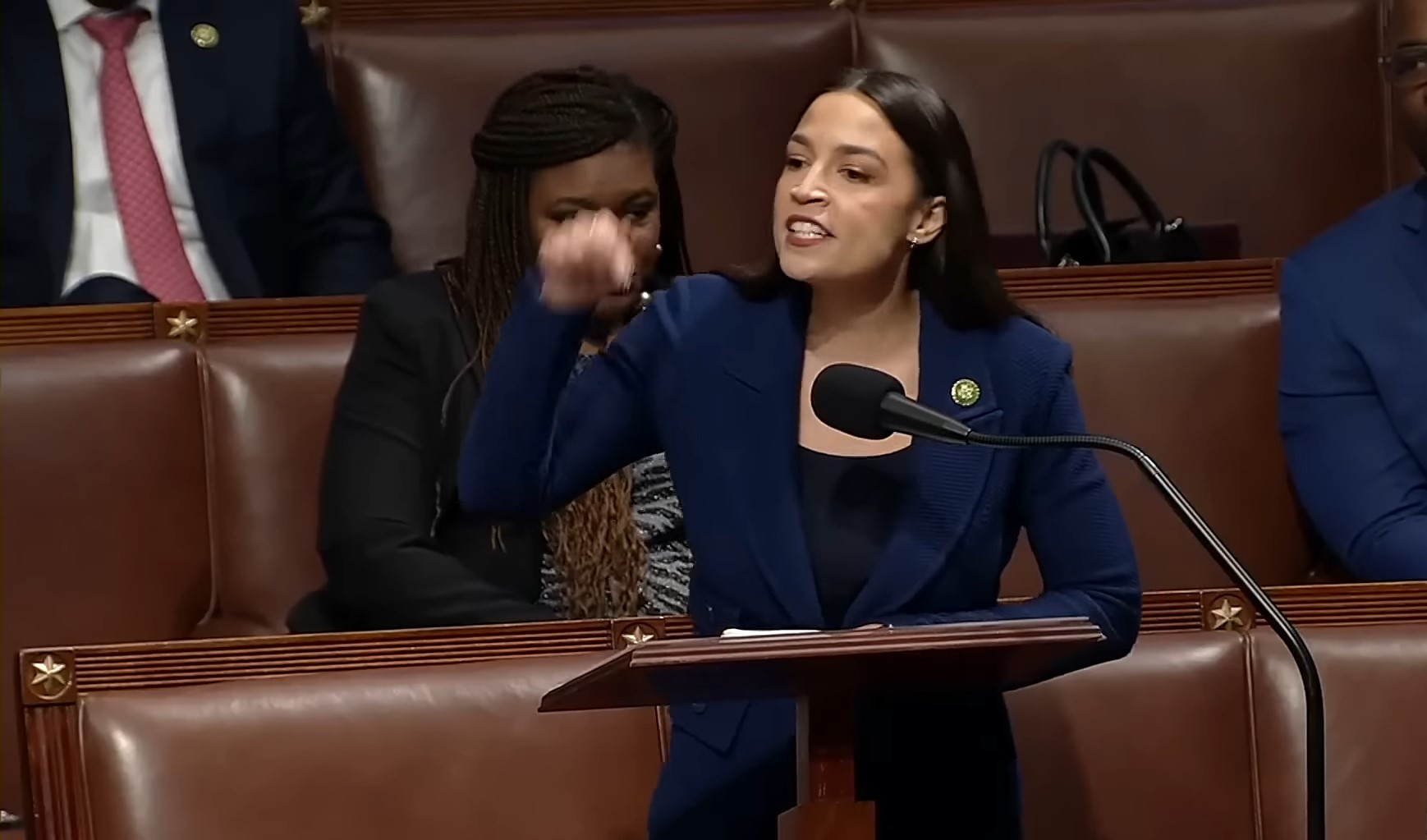

Democrats sent Rep. Alexandria Ocasio-Cortez to the Munich Security Conference to represent the United States, and the result was exactly what you would expect when Instagram politics collides with serious foreign policy.
The Munich Security Conference is not a college town hall. It is a high level global forum where heads of state, defense ministers, military officials, and policy experts debate war, peace, deterrence, and alliances. In other words, this is the big leagues.
So what happened when AOC was asked a straightforward question about whether the United States should commit troops to defend Taiwan in the event of a Chinese invasion?
Word salad.
When pressed on the issue, she stalled for roughly 20 seconds and began fumbling through a response: “Um, you know, I think that, uhh, eh, this is such a, uh, you know, I th-I think that this is a, umm, this is of course a, uh, a very longstanding, um, policy.” Eventually she added that the United States should try to avoid reaching that point with China in the first place.
That is not exactly a Churchillian moment.
Even The New York Times, not exactly a hostile outlet when it comes to progressive Democrats, admitted she “struggled” on the world stage. The paper noted that she does not sit on any House committees primarily devoted to foreign affairs and has limited experience in international policy. During another panel, she even referenced the “Trans-Pacific Partnership” before later correcting herself to “trans-Atlantic” on social media.
Speculation was already swirling in Munich about her future ambitions. She has long been floated as a potential presidential candidate, and her presence at the conference fueled talk that she may be testing the waters for 2028. A New York Times moderator even asked her directly, “So when you run for president, how are you going to impose a wealth tax?” Ocasio-Cortez laughed and deflected.
Here is the problem. Representing the United States abroad requires more than confidence and social media savvy. When allies and adversaries alike are listening, hesitation and vague platitudes do not inspire trust. Taiwan is not a theoretical debate topic. It is a potential flashpoint between the United States and China, two nuclear powers.
Foreign policy demands clarity. It demands preparation. It demands seriousness.
Instead, what viewers saw was a moment that critics immediately seized on as evidence that progressive politics does not automatically translate into global leadership. When the lights are bright and the stakes are high, improvisation is not a strategy.
If this was meant to showcase presidential readiness, it did not land that way. On the world stage, there is no editing button.
Leave a Comment