
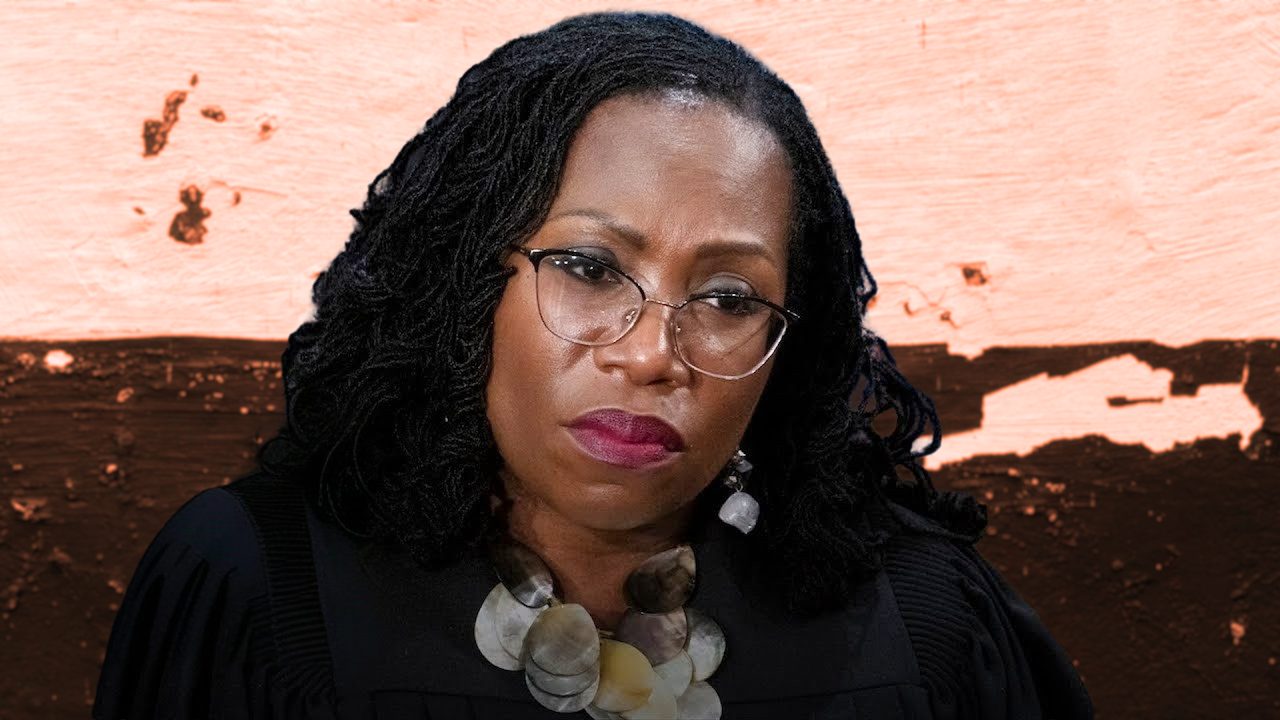

Justice Ketanji Brown Jackson is once again planting herself firmly on the activist side of the Supreme Court, this time objecting after the justices sent a pair of major voting rights cases back to lower courts for reconsideration. The move came Monday after the Supreme Court’s recent Louisiana v. Callais decision, a ruling that is already shaking up redistricting battles across the country and sending Democrats into full panic mode ahead of the 2026 midterms.
The Supreme Court ordered lower courts in both Mississippi and North Dakota to revisit disputes involving congressional maps and Voting Rights Act claims. The justices did not issue a lengthy opinion this time around. Instead, they instructed the lower courts to apply the legal framework established in the Louisiana case, which dramatically narrowed how courts should analyze certain racial gerrymandering claims tied to Section 2 of the Voting Rights Act.
Jackson was not happy about it.
In a dissent Monday, Jackson argued the Supreme Court should have done more than simply remand the cases for another look. That reaction fits neatly into her growing reputation as one of the court’s loudest liberal voices on election law and redistricting issues. Since joining the bench, Jackson has consistently sided with arguments favoring expansive federal intervention in election disputes, usually under the banner of “protecting democracy,” which in modern Washington often translates into courts micromanaging state election maps indefinitely.
One of the cases involves North Dakota and a major question that could have national implications. The dispute centers on whether private citizens and activist groups even have the authority to sue under Section 2 of the Voting Rights Act. A lower appeals court ruled that only the federal government can bring those claims, a decision that immediately triggered outrage from voting rights organizations and tribal groups challenging the state’s legislative maps.
You can understand why activists are nervous. If private groups lose the ability to file these lawsuits, the endless stream of politically charged redistricting cases flooding federal courts every election cycle could slow down considerably. Naturally, that possibility is treated like a constitutional apocalypse by the usual crowd.
The Mississippi case focuses on claims that congressional districts diluted Black voting strength. Again, the Supreme Court did not resolve the substance of the dispute Monday. Instead, it told lower courts to reconsider the matter under the standards established in Louisiana v. Callais.
That Louisiana ruling was a significant victory for conservatives concerned about race becoming the dominant factor in drawing congressional districts. In a 6-3 decision last month, the court ruled that Louisiana’s map containing a second majority-Black district amounted to an unconstitutional racial gerrymander. Justice Samuel Alito, writing for the majority, made clear that race cannot predominate in redistricting simply to satisfy Section 2 demands.
That sentence alone probably caused several MSNBC panel discussions to spontaneously combust.
The ruling is already igniting fresh political warfare across Southern states where Republicans are preparing to redraw congressional maps before the 2026 elections. Democrats and activist groups are expected to challenge nearly every line with the enthusiasm of a toddler smashing elevator buttons.
For conservatives, though, the Supreme Court’s direction signals a return to a more basic constitutional principle: states cannot sort voters primarily by race just because political activists demand a certain electoral outcome. Jackson’s dissent shows the ideological divide on the court is only getting sharper as the next round of redistricting battles heats up.
Leave a Comment