
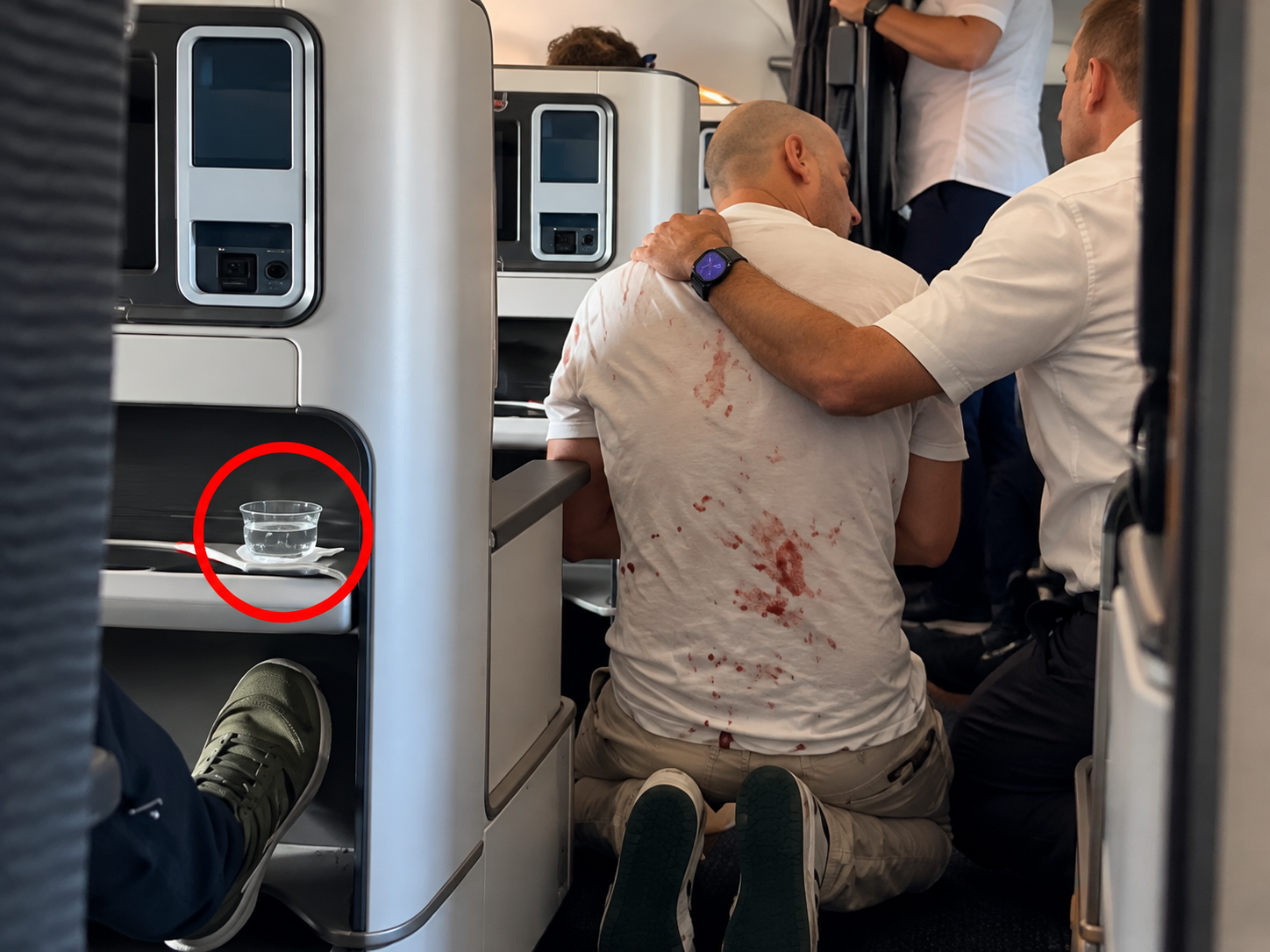

The extraordinary story of FlyDubai Flight FZ1073 already sounds like something Hollywood would reject for being a little too convenient.
A co-pilot allegedly attacks the captain. The aircraft plunges thousands of feet. The badly wounded captain manages to open the cockpit. Passengers overpower the attacker. An Israeli plumber grabs the controls despite having no formal flight training. Two reserve pilots ultimately take over and land the Boeing 737 MAX safely in Saudi Arabia.
Remarkably, the broad outlines of that story are being reported by multiple major news organizations. What remains unresolved is exactly how the dramatic sequence unfolded and whether some early claims about the aircraft’s movements accurately describe what happened.
According to Reuters, flight data showed the aircraft losing more than 16,000 feet in roughly 30 seconds at one stage, with extreme changes in altitude and speed. The injured captain reportedly managed to unlock the cockpit door, allowing passengers to intervene. Reserve pilots aboard the flight later landed the aircraft in Tabuk.
That is already astonishing enough without filling in the unanswered blanks.
President Trump added another layer Thursday when he publicly congratulated Boeing for building a 737 MAX capable of surviving what he described as forces beyond its expected design limits.
“Congratulations to the GREAT Boeing Company for producing a plane, the 737 Max, that was able to withstand G Forces and Strain far beyond what it was designed and expected to do,” President Trump wrote.
The comment prompted speculation online that President Trump was sarcastically questioning the official account. But his post itself does not explicitly say that, and there is currently no public evidence establishing that interpretation. Aviation reporting has likewise noted that investigators have not yet released the engineering data necessary to determine precisely what structural forces the aircraft experienced.
Then there is plumber Yaniv Hayoun.
Hayoun reportedly helped bring the aircraft under control during the emergency and said familiarity with aviation-disaster programming helped him understand what to do. Reports indicate, however, that he was not responsible for actually landing the aircraft. Two off-duty or reserve pilots eventually assumed control and brought it safely to Tabuk.
The episode has inevitably generated conspiracy theories, including accusations online that the incident was an Israeli “false flag.” No credible evidence has emerged supporting that allegation.
The attacker’s motive also remains under investigation. Israeli Prime Minister Benjamin Netanyahu has said the Omani co-pilot had undergone Islamist radicalization, while UAE authorities opened an investigation into whether the incident involved terrorism, premeditation or outside direction. Reuters reported that investigators had found no evidence linking Iran to the attack at that stage.
That distinction matters because extraordinary events do not become fabricated merely because they sound extraordinary.
There are legitimate questions here. Investigators need to explain the flight data, cockpit sequence, security failures, aircraft stresses and actions of everyone involved. Claims circulating on social media about what passengers physically could or could not have done also deserve comparison with actual flight-recorder and engineering evidence rather than viral speculation.
For now, the verified story is strange enough: a captain was attacked, an airliner plunged dramatically, passengers intervened, additional pilots ultimately took control, and everybody aboard survived.
Whether every sensational detail attached to that story survives the investigation is another question entirely.
Leave a Comment