
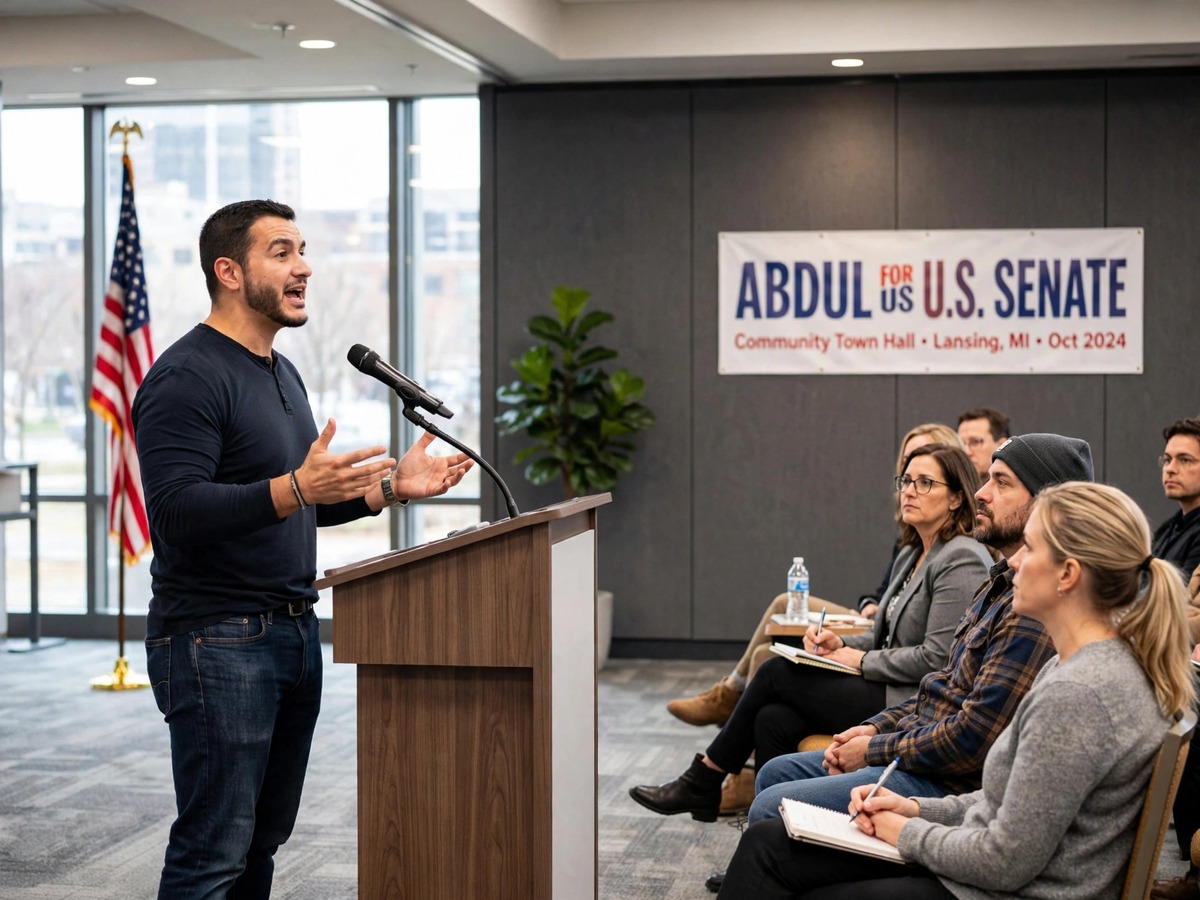

A Michigan Senate debate over surveillance turned into a sharp confrontation when Republican Mike Rogers challenged Democrat Abdul El-Sayed over El-Sayed’s biological mother’s former employment with the Islamic American Relief Agency, known as IARA-USA. The subject was hardly a routine policy disagreement, and the exchange quickly moved from surveillance to family history.
El-Sayed accused Rogers of targeting his mother. Rogers responded that he was targeting the organization where she worked, then compared that employment with his own mother’s job at a local chamber of commerce. Political debates are not exactly famous for avoiding dramatic personal contrasts, and this one put the issue in front of Michigan voters in a hurry. Fatten Elkomy held a role at IARA-USA, the American office of a larger international network.
The federal record cited by Rogers is serious, but it requires a careful line between an organization and an individual. In October 2004, the U.S. Department of the Treasury designated the worldwide Islamic African Relief Agency network and five senior officials under Executive Order 13224. The action blocked the network’s U.S. funds and made providing money or support to its offices a crime. Treasury listed Islamic American Relief Agency as an alias. The department said international IARA offices provided direct financial support to Osama bin Laden, including hundreds of thousands of dollars sent to him in 1999. The notice also described cooperation with an institute controlled by bin Laden that assisted Taliban fighters. Treasury separately accused the network of acting as a conduit to Hamas in Western Europe and supporting Al-Ittihad Al-Islamiya.
That designation came near the end of Elkomy’s reported employment period. It gives Rogers a documented foundation for raising IARA-USA, but it does not establish Elkomy’s personal knowledge or intent. That distinction may be inconvenient for a heated campaign exchange, but inconvenient facts are still facts.
Years later, the U.S. Department of Justice secured IARA’s guilty plea to sanctions violations involving nearly $1.4 million transferred to Iraq. The organization also pleaded guilty to conspiracy to commit money laundering and obstruction of tax administration. The case followed a lengthy federal investigation into the Missouri-based U.S. office. Prosecutors said the group moved money to Iraq while sanctions were in force and then tried to conceal its conduct from federal authorities. An earlier superseding indictment accused IARA and several former officers of prohibited transactions for the benefit of U.S.-designated terrorist Gulbuddin Hekmatyar, along with efforts to hide unlawful acts through false and misleading statements.
Those pleas established crimes by the organization. They did not turn every employee into a participant, and the public federal record reviewed for this account does not show Elkomy was charged. The federal actions concern IARA and its broader network. They do not establish that Elkomy participated in terrorism financing. That is the boundary between a documented employment connection and a claim the evidence does not support.
WLT Report previously examined court exhibits that place Elkomy’s name on IARA correspondence and transfer paperwork. One exhibit description identifies a December 2000 request to transfer roughly $24,600 to the organization’s Iraq office. Other entries describe correspondence involving sponsorship money for orphans and refugees in Jordan and Iraq. Her name also appears in descriptions of recorded calls and internal letters from the same period. The records establish that she worked with the organization and handled financial paperwork. They do not say she sent money to al-Qaeda, Hamas, or the Taliban.
On live television, Rogers raised the organization’s history, while El-Sayed challenged the implication and the moderator moved the debate forward. Michigan voters can consider the documented connection, the federal actions against IARA, and the absence of a charge against Elkomy without confusing those separate points. Politics rewards dramatic accusations, but the record here demands precision. The organization’s conduct is one question; an individual employee’s knowledge and intent are another.
Leave a Comment