
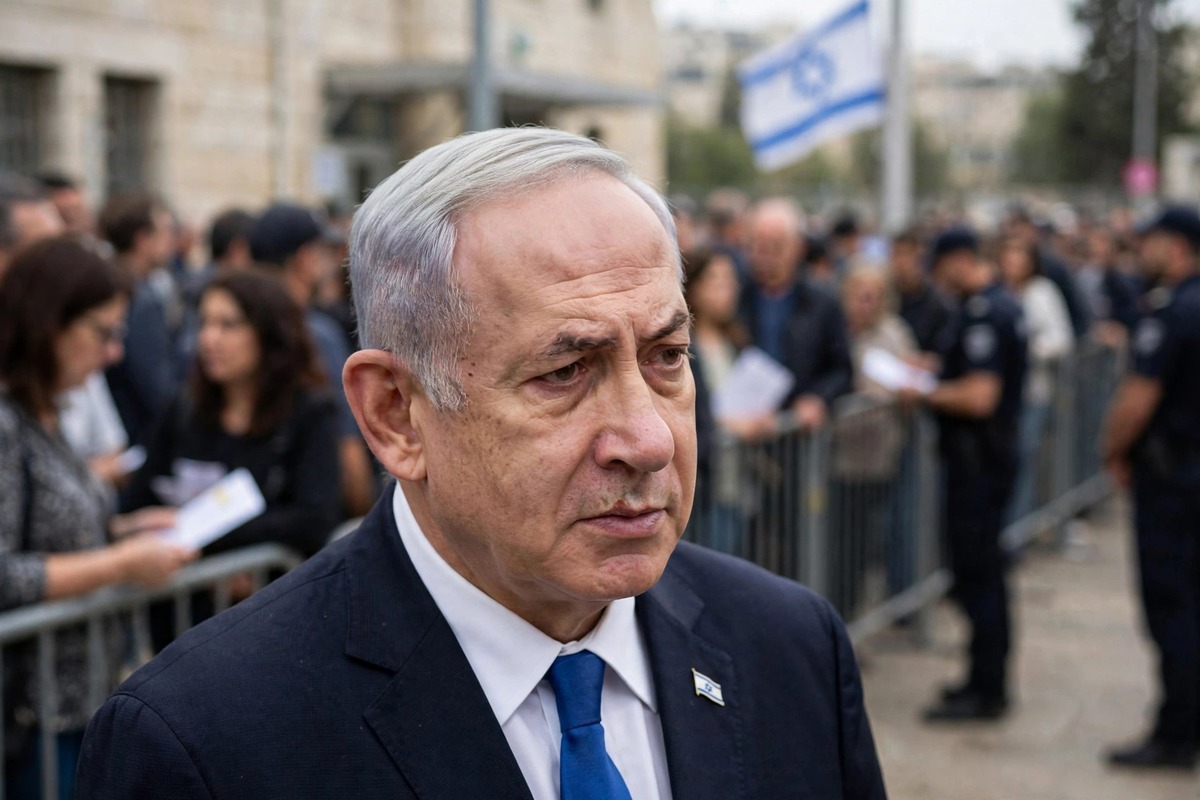

Israel’s election has produced the kind of political headache that makes coalition arithmetic look like a national sport. Prime Minister Benjamin Netanyahu’s Likud party finished as the largest individual party, but the right-wing and religious bloc that has kept him in power came in at 53 seats, eight short of the 61 needed to control the Knesset.
Former military chief Gadi Eisenkot’s opposition bloc held 48 seats, while Arab-led parties surged to a record 19. That means neither side gets a clean victory lap. Netanyahu was not decisively defeated, Eisenkot did not win a governing majority, and the parties some establishment figures treated as an afterthought may now hold the leverage needed to determine who forms Israel’s next government. Nothing says political stability quite like a government being assembled through negotiations among parties that spent the campaign eyeing one another suspiciously.
An early post-election reaction said the Joint List, led by Yousef Jabareen, would join Eisenkot to support Palestinian rights after the record gain among Israeli-Arab voters.
That post captured how quickly Arab-led parties moved to the center of the political conversation. Still, a social-media declaration is not the same thing as a signed coalition agreement. The final seat count, formal certification and actual commitments from party leaders will determine whether the proposed partnership survives contact with political reality.
Turnout was another major feature of the election. The source reports that participation reached its highest level in nearly three decades, with the surge especially important in Arab communities. The Joint List and Ra’am reached a combined 19 seats, a new record. A post from Representative Tom Suozzi highlighted participation by 5.5 million Jewish, Christian and Arab Israelis and described the election as potentially historic.
The Associated Press described the election as a referendum on Netanyahu’s long rule and on Israel’s direction after years of war and political turmoil. The result now points toward weeks of bargaining, with another election possible if no faction can assemble a majority. Voters delivered arithmetic, not a tidy governing mandate. Apparently, even politics in Israel occasionally refuses to provide a simple television ending.
Eisenkot’s 48-seat bloc could theoretically move past 61 with support from Arab-led parties. The problem is that several opposition factions spent the campaign ruling out that partnership. Those promises will now face serious pressure. Netanyahu has a different version of the same problem. His bloc needs eight additional seats, meaning he would have to draw opposition lawmakers into a new arrangement, split a rival faction or find another coalition formula that looked unlikely before the ballots were counted.
Yair Golan, leader of Israel’s Democrats party, argued that Netanyahu had lost when the anti-Netanyahu and Arab-led parties were counted together. Golan wrote: “נתניהו הפסיד. אני יודע לספור עד 120. 65 זה יותר מ-55. ככה עובדת הדמוקרטיה הישראלית. נקודה. תמונת המציאות חייבת ללמד אותנו לקח אחד מהדהד: אין לנו עתיד כאן אם לא נפסיק לפחד. ואם לא נפסיק עם הגזענות. אסור לנו לקבל יותר את החלוקה הגזענית של נתניהו בין קולות יהודיים לקולות ערביים.…”
But counting seats on paper is not the same as building a government. A coalition needs parties willing to sit together, accept a common program and survive a confidence vote. That remains unresolved, particularly when campaign promises were built around refusing certain alliances.
Foreign-interference allegations have added another layer of uncertainty. President Isaac Herzog said he spoke with Central Elections Committee Chairman Justice Noam Sohlberg and Shin Bet chief David Zini as the allegations spread. Herzog called the integrity of Israel’s elections a supreme democratic value and said every piece of evidence and every allegation must be fully investigated. He also stressed that official results would be presented only after the legally required process was complete, after which he would consult with the elected factions with an open mind.
For now, Israel has an election result but not a government. Netanyahu retains a possible route, Eisenkot has a possible route, and Arab-led parties hold pivotal seats. Formal certification and coalition talks will determine whether any of those routes reaches 61. The next stage will be less about campaign slogans and more about which politicians are willing to sit at the same table, where promises have a habit of developing remarkably short memories.
Leave a Comment