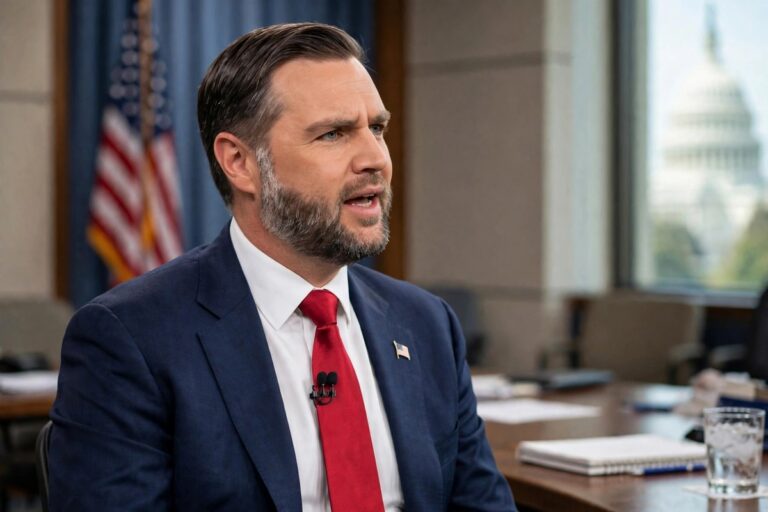
Vice President JD Vance abruptly canceled a major New York City appearance Wednesday, just 20 to 30 minutes before he was expected to take the stage at The New York Times’ DealBook Summit. That is not the sort of calendar change that gets made with a casual, “Something came up.”
Summit host Andrew Ross Sorkin announced that Vance would not attend after Secret Service personnel had reportedly spent the night preparing for his arrival in Manhattan. Vance was instead needed back in Washington for meetings connected to a broad wave of technology failures affecting banks, airlines, government systems, and major communications platforms.
The New York Times reported that the meetings involved disruptions tied to Microsoft, the National Security Agency, an airline ground stop, JPMorgan, and Zelle. Vance’s office confirmed that he was attending meetings in Washington, although officials did not immediately release a detailed public agenda.
That sudden reversal naturally raised questions. Were Americans seeing several unrelated breakdowns at the same time, or were the failures connected? The Trump administration says its intelligence review found no evidence of a coordinated cyberattack, a state-sponsored operation, or another malign actor behind the disruptions.
Director of National Intelligence Jay Clayton said officials examined the possibility of a unified hostile campaign and did not believe the outages were part of one. National Security Adviser Marco Rubio said the Microsoft incident, the Federal Aviation Administration disruption, and the banking problems appeared to have separate causes.
Rubio put the administration’s assessment plainly: “We have no indication, no evidence, and no reason to believe at all that any of these incidents are related to each other… We have zero evidence or any reason to believe that any of these isolated or individual instances have anything to do with nefarious actors.”
That may be the official conclusion, but it does not make the disruptions unimportant. When banks, airlines, government communications, and major online services all experience trouble around the same time, officials have a legitimate reason to ask questions. Apparently, that question was important enough to keep the vice president in Washington instead of sending him to a high-profile media event.
Microsoft’s own incident updates described a major service degradation affecting Exchange Online, Outlook, Teams, and other Microsoft 365 services. The company identified the problems under incident numbers EX1550543 and MO1550821, saying servers had unexpectedly become unavailable. Engineers worked to restart and repair the affected infrastructure while services were restored in stages.
Microsoft described the strain as an infrastructure problem, not a verified cyberattack. Its support record established a concrete outage and an active recovery effort, but it did not establish that the company’s problems shared a cause with the airline, banking, or government disruptions.
Vance’s cancellation does not prove that the failures were coordinated, and the administration has expressly rejected that conclusion. It does show that the overlapping disruptions were serious enough to trigger meetings in Washington, while Secret Service preparations in New York suddenly became irrelevant. Politics can wait for another day. Apparently, malfunctioning infrastructure could not.
Source: WLT Report