
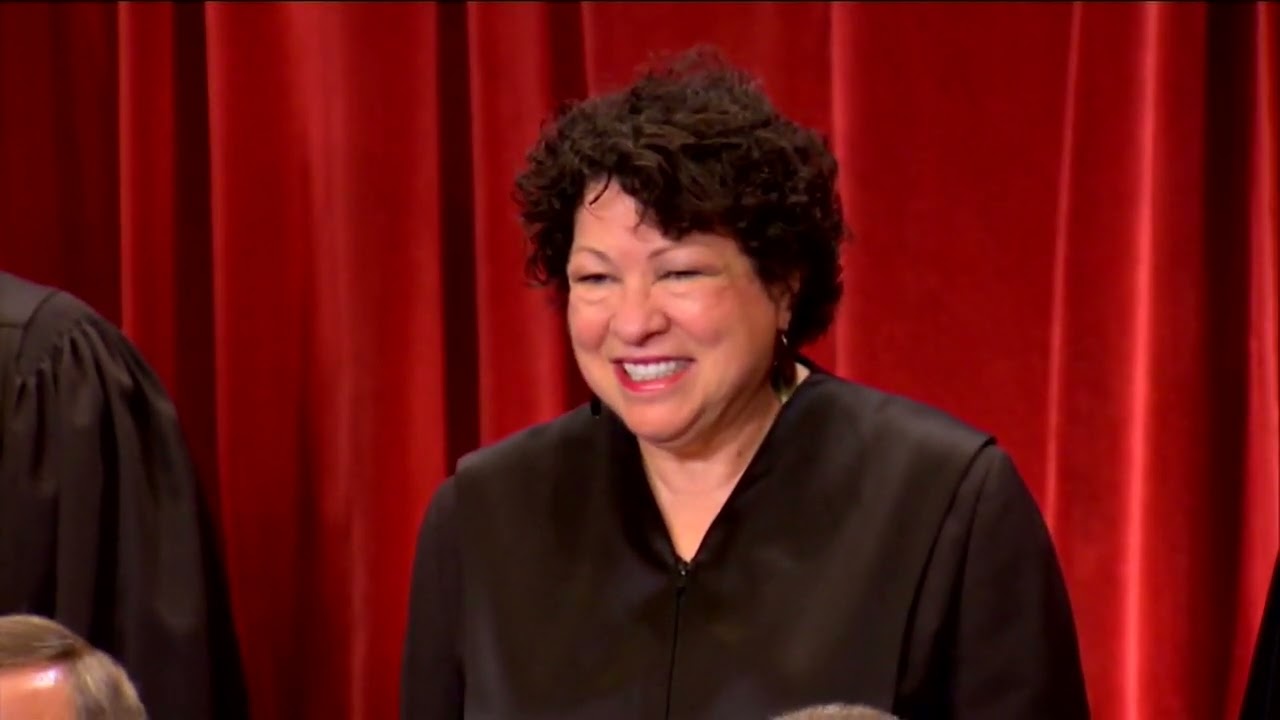

Supreme Court oral arguments are usually where legal precision meets constitutional seriousness. Then every once in a while, someone decides to toss in a line that sounds more like a cable news talking point than a legal argument, and things go sideways fast. That is exactly what happened when Justice Sonia Sotomayor tried to defend the never-ending push for late-arriving mail-in ballots.
The case itself is pretty straightforward. The Republican National Committee and the Libertarian Party of Mississippi are challenging the idea that ballots can just show up whenever they feel like it, long after Election Day, and still be counted. On the other side, you have Democrat officials and activist groups trying to stretch “states’ rights” into a convenient excuse for loosening election standards. Funny how “states’ rights” only seem to matter when it helps their side.
Enter Sotomayor, who decided to bring up the 2000 Florida election as some kind of gotcha moment. She quipped, “Maybe we should have another president now, because wasn’t it in Florida that they were counting military votes after receipt?” The implication was obvious. If late ballots were counted back then, why not now?
It sounded clever for about five seconds.
Then Paul Clement, representing the RNC, calmly dismantled the entire argument. Not with theatrics, not with outrage, just with facts. He called it “the reddest of red herrings,” which is about as polite as you can be while saying, “this has nothing to do with anything.”
And he was right.
What happened in Florida in 2000 was not some free-for-all of ballots trickling in whenever. It was a very specific situation involving military and overseas voters under the Uniformed and Overseas Citizens Absentee Voting Act. That law requires states to send ballots out at least 45 days in advance. Florida failed to do that, meaning service members were at risk of being disenfranchised through no fault of their own.
So what happened? A federal court stepped in and created a consent decree to fix the state’s mistake. It was a targeted remedy for a specific legal violation, not a blanket permission slip for late ballots across the board.
That distinction matters. A lot.
Comparing a court-ordered fix for military voting issues to modern efforts to count ballots arriving days after an election is like comparing a fire extinguisher to arson. One is a controlled response to a problem, the other creates the problem.
This is where the broader issue comes into focus. Delayed ballot counting is not just some harmless administrative quirk. It drags out election results, erodes public trust, and opens the door to exactly the kind of chaos people worry about. Even if fraud is rare, the perception of a system that never seems to close is a problem all on its own.
Clement didn’t need to raise his voice or make it political. He just pointed out the obvious. The law in 2000 addressed a failure to follow federal requirements. Today’s push is about changing the rules after the fact.
And once you see that difference, Sotomayor’s “zinger” stops looking clever and starts looking like what it actually was, a talking point that didn’t survive contact with reality.
Leave a Comment