
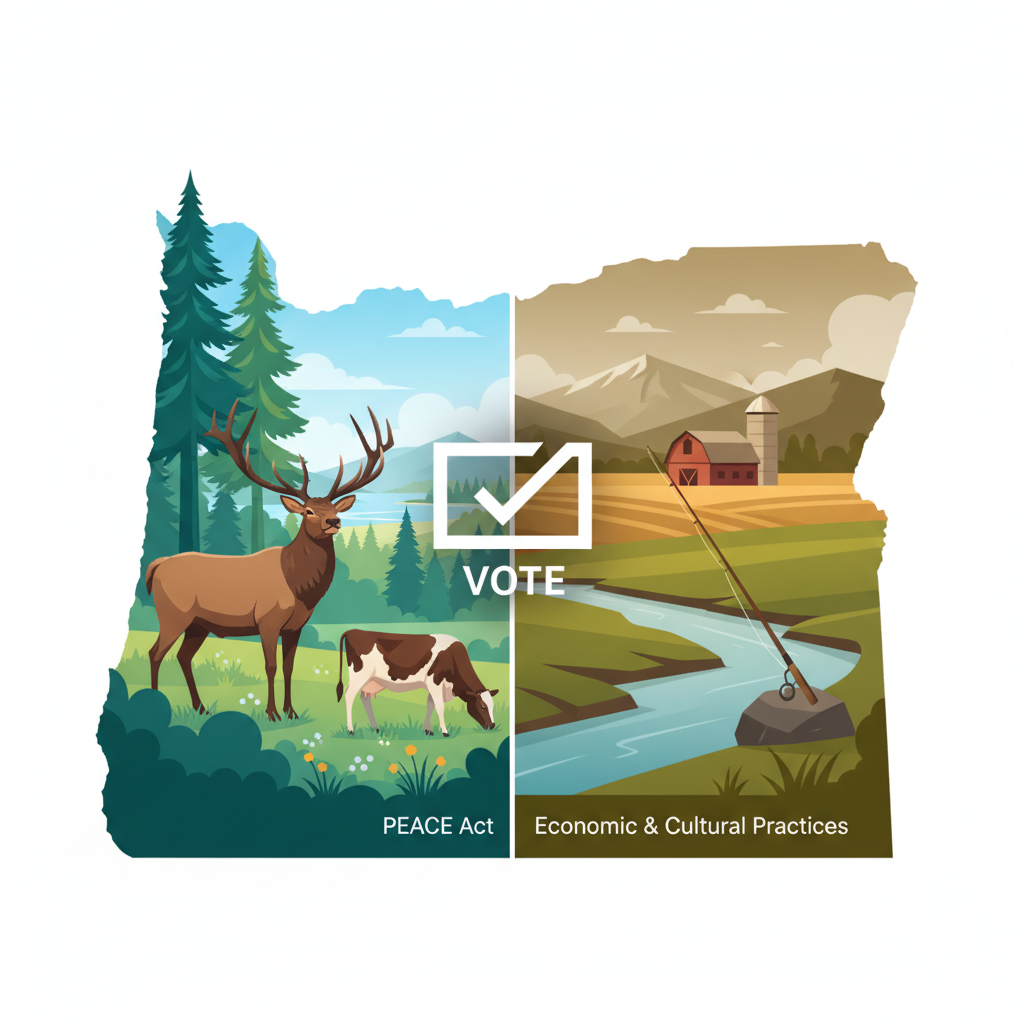

Oregon may soon become ground zero for one of the most sweeping animal rights proposals ever put before voters.
Initiative Petition 28, also known as the PEACE Act, is nearing the 117,713 verified signatures required to qualify for the November ballot. Organizer David Michelson says supporters have already gathered roughly 105,000 signatures and are racing toward the July 2 deadline.
If approved, the measure would extend legal protections currently applied to pets like dogs and cats to wild animals, livestock, and animals used in research. In practical terms, that would effectively ban hunting and severely restrict ranching across the state. Exceptions would exist for veterinarians and for killing animals in self defense, but routine livestock slaughter and wildlife harvesting would face sweeping new legal hurdles.
Michelson has acknowledged the uphill climb. “We are aware that it’s unlikely 50 percent of Oregonians are ready right now to move away from killing animals,” he told KOIN. “But we want to get that conversation out there.”
That “conversation” would have massive economic consequences.
According to a February 2025 report from Oregon State University, cattle ranching contributes over $900 million annually to Oregon’s economy. Approximately 15 million acres of rangeland and pastureland are used for grazing, and roughly 11,000 cattle ranches operate in the state, primarily in Southern and Eastern Oregon.
Amy Patrick of the Oregon Hunters Association warned that voters should not assume the measure would only affect hunters and ranchers. “Part of what makes Oregon great is our wildlife and part of that is our economy that comes from our farming and ranching,” she said. “Don’t think that this is not going to affect you in your day to day life.”
Levi Barrera, president of the Hoodview Chapter of the Oregon Hunters Association, cautioned that eliminating hunting would have unintended ecological consequences. “If you take away hunting, there will be an out of control effect on the population,” he said. He also pointed to the practical reality that many families rely on hunting and fishing to supplement their food supply, especially as grocery prices remain elevated.
Those concerns are amplified nationally. The U.S. cattle herd has fallen to a record low of 86.2 million head as of January 2026. Ground beef prices hit $6.69 per pound in December 2025, the highest since tracking began in the 1980s. President Trump has responded by authorizing an additional 80,000 tons of tariff free beef imports from Argentina to stabilize prices.
Michelson argues the PEACE Act would include transition funding and require non lethal wildlife management, such as introducing sterile males to control populations.
Voters will soon decide whether Oregon becomes the first state to test that theory, or whether agriculture and hunting remain foundational to its economy and culture.
Leave a Comment