
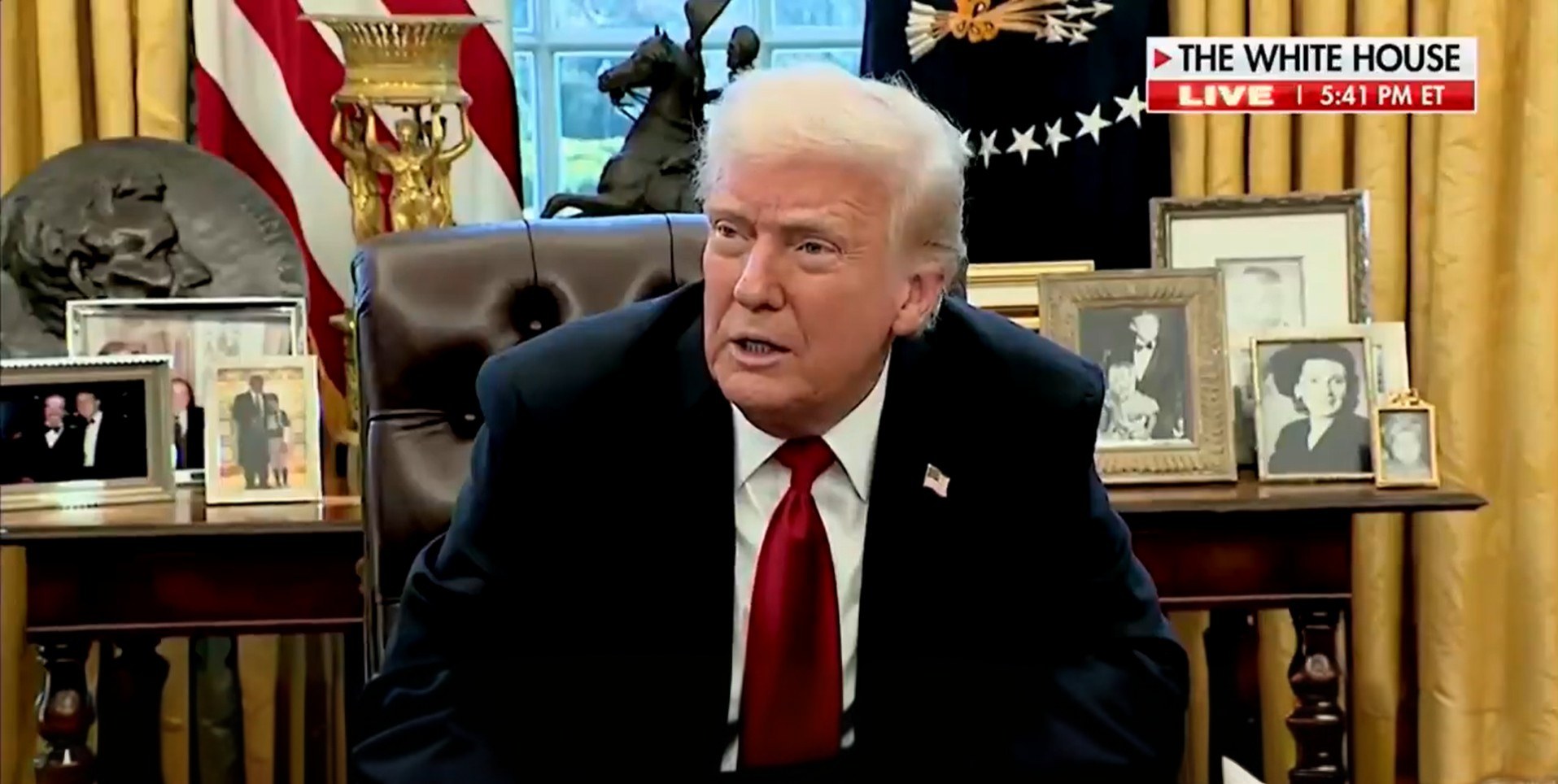

President Trump convened a high-stakes meeting in the White House Situation Room on Saturday as tensions surrounding the Strait of Hormuz and ongoing negotiations with Iran entered a critical phase. With a fragile ceasefire nearing expiration and fresh threats emerging from Tehran, the administration appears to be preparing for every possible outcome, diplomatic breakthrough, renewed confrontation, or the usual Iranian strategy of saying one thing in the morning and doing the opposite by dinner.
According to reports, the meeting included Vice President JD Vance, Secretary of State Marco Rubio, Defense Secretary Pete Hegseth, Treasury Secretary Scott Bessent, Chief of Staff Susie Wiles, envoy Steve Witkoff, CIA Director John Ratcliffe, and Joint Chiefs Chairman Dan Caine. In short, when that many senior officials are in the Situation Room on a Saturday, it is not to discuss brunch plans.
The central issue was Iran’s shifting position on the Strait of Hormuz, one of the most important shipping lanes in the world. A significant portion of global energy supplies moves through that narrow waterway, which means every threat made there sends markets, governments, and nervous investors into immediate reaction mode.
President Trump told reporters that discussions with Iran were progressing, calling them “very good conversations.” But he also made clear he was not fooled by Tehran’s tactics. Referring to Iran’s latest moves, Trump said the regime “got a little cute … they wanted to close up the Strait again,” before adding, “Iran can’t blackmail us.”
That line likely landed well with Americans tired of watching hostile regimes use global commerce as leverage while expecting concessions in return.
Just a day earlier, Iranian officials announced commercial traffic through the strait would remain open during the ceasefire period. Markets rallied, commentators declared progress, and the usual experts began drafting columns about diplomatic momentum. Then reality returned. Iranian leaders quickly walked back the opening, calling it conditional on changes to the U.S. naval blockade of Iranian ports.
By Saturday, the Islamic Revolutionary Guards Corps reportedly reimposed restrictions entirely. Reports indicated IRGC gunboats fired on at least one tanker attempting to transit the waterway, with multiple vessels warning of attacks during the brief reopening.
So, to summarize the Iranian negotiating model, announce peace, threaten retaliation, reverse course, blame everyone else, repeat as needed.
The United States has maintained its blockade of Iranian ports after earlier talks collapsed. President Trump has stated clearly that pressure will continue until a comprehensive agreement is reached. That approach reflects a basic truth often ignored by foreign policy theorists, leverage only works if you actually use it.
With the ceasefire set to expire in the coming days, the stakes are obvious. If diplomacy succeeds, global markets stabilize and conflict is avoided. If it fails, the region could be back on edge immediately.
For now, the administration is signaling readiness, patience, and strength. In dealing with Tehran, that combination tends to be more effective than apologies and wishful thinking.
Leave a Comment