
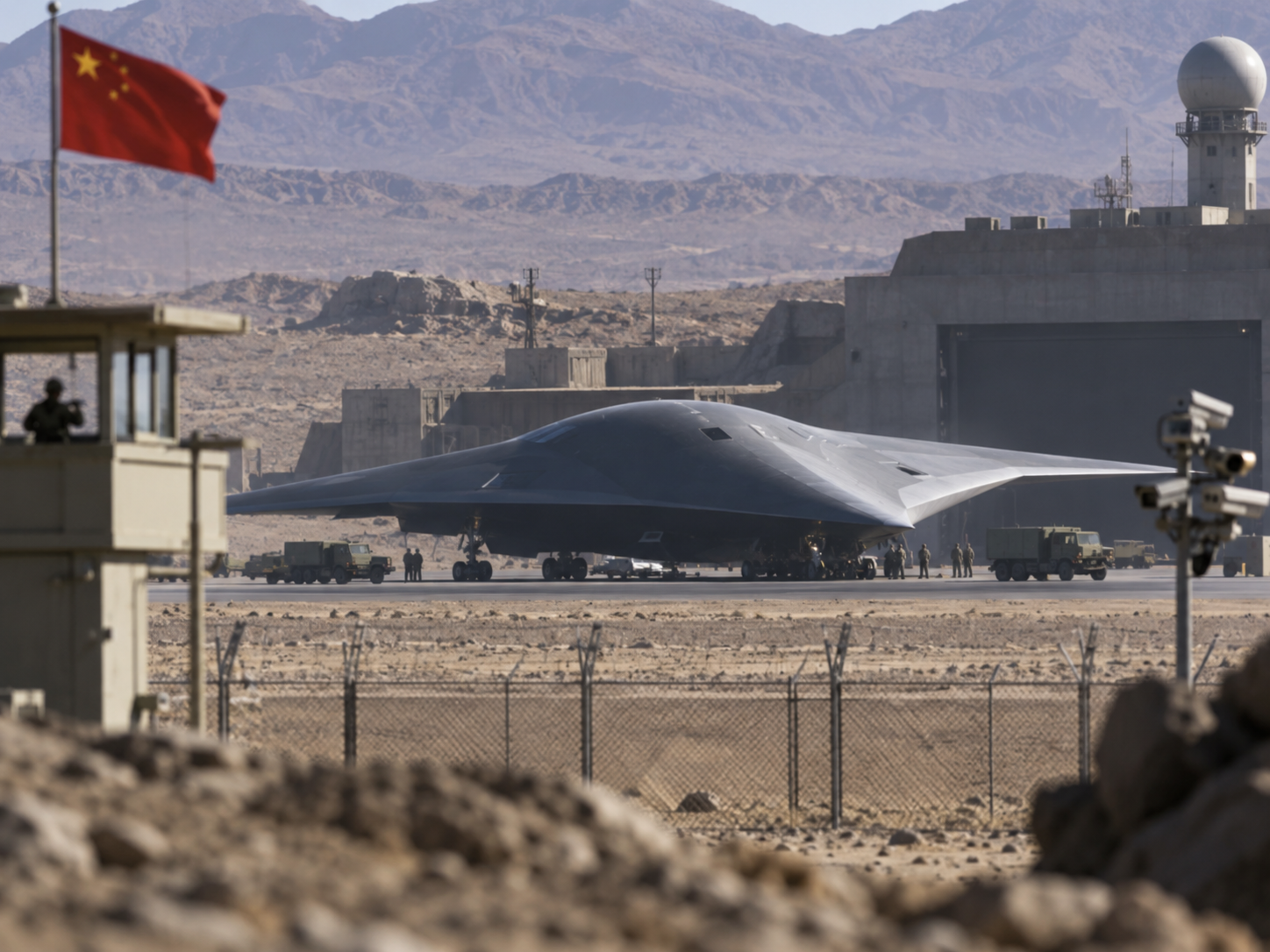

China appears to be testing a massive new stealth drone with a wingspan approaching that of America’s B-2 Spirit, offering another glimpse into Beijing’s rapidly developing unmanned aviation programs.
The mysterious aircraft is commonly referred to by outside observers as the WZ-X, although that designation has not been officially confirmed by China’s military. New images circulating from China reportedly show the flying-wing aircraft airborne near Malan Air Base in Xinjiang, a secretive testing facility that has become associated with some of Beijing’s most advanced aircraft programs.
And this thing is not exactly a hobby-store quadcopter.
Aviation researcher Andreas Rupprecht, who closely follows Chinese military aviation, has assessed the aircraft as a probable twin-engine, high-altitude, long-endurance unmanned platform intended primarily for intelligence, surveillance and reconnaissance.
The aircraft reportedly first attracted widespread attention after appearing in commercial satellite imagery of Malan in May 2025.
What immediately stands out is its enormous size.
Estimates put the WZ-X’s wingspan at approximately 170 to 173 feet. America’s B-2 Spirit stealth bomber has a wingspan of approximately 172 feet. That does not mean the two aircraft have the same capabilities or mission, but the comparison gives some perspective on just how large China’s experimental drone appears to be.
The similarities largely end there.
The B-2 is a nuclear-capable strategic bomber. Analysts examining the WZ-X have instead pointed toward its unusually long wings and comparatively compact center section as indications that endurance, altitude and reconnaissance may be its primary purposes.
Rupprecht has estimated that the aircraft could potentially have a range exceeding 12,000 miles and operate at altitudes between roughly 59,000 and 66,000 feet. Those numbers have not been confirmed by the People’s Liberation Army Air Force, so they remain informed estimates rather than established specifications.
If remotely accurate, however, they suggest an aircraft capable of conducting extraordinarily long surveillance missions.
Such a drone could potentially be used to monitor warships, military installations and air-defense systems while gathering intelligence or passing targeting information to other Chinese forces. In the Pacific, where American and Chinese forces routinely watch each other’s movements, a stealthy, high-altitude drone with enormous endurance would be an important capability.
The aircraft’s flying-wing configuration is also notable. Flying-wing designs can reduce radar signatures because they eliminate some of the vertical surfaces and other features that readily reflect radar energy. High-altitude operation could provide additional advantages for surveillance, particularly when combined with long endurance and advanced sensors.
Exactly what sensors the WZ-X carries is unknown. Whether it has any weapons capability is equally unclear. Analysts have generally concentrated on a reconnaissance mission rather than treating the aircraft as a confirmed strike platform.
There are obvious comparisons with America’s secretive RQ-180 reconnaissance aircraft, although publicly available information about that American program remains limited and the apparent Chinese aircraft looks considerably larger.
Then there is Malan itself.
The remote Xinjiang facility has increasingly attracted attention as China’s answer, at least in broad terms, to America’s famous Area 51. Satellite imagery has revealed expanding infrastructure there, including facilities associated with testing advanced unmanned aircraft.
The WZ-X apparently is not alone. Another large flying-wing aircraft, sometimes called the GJ-X by observers, has also been identified at Malan. That aircraft reportedly uses a different cranked-kite configuration and has an estimated 137-foot wingspan.
China’s military has revealed remarkably little about either aircraft. Even their commonly used names remain unofficial.
That leaves plenty of unanswered questions about propulsion, sensors, stealth characteristics, operational range and whether either design will eventually enter production.
But an aircraft does not need an official press release from Beijing to deserve attention. A drone roughly as wide as a B-2 apparently taking flight at a secretive Chinese test base is another indication of how heavily China is investing in long-range unmanned aviation. For American military planners watching developments across the Pacific, figuring out exactly what this enormous aircraft can do will undoubtedly be a priority.
Leave a Comment