
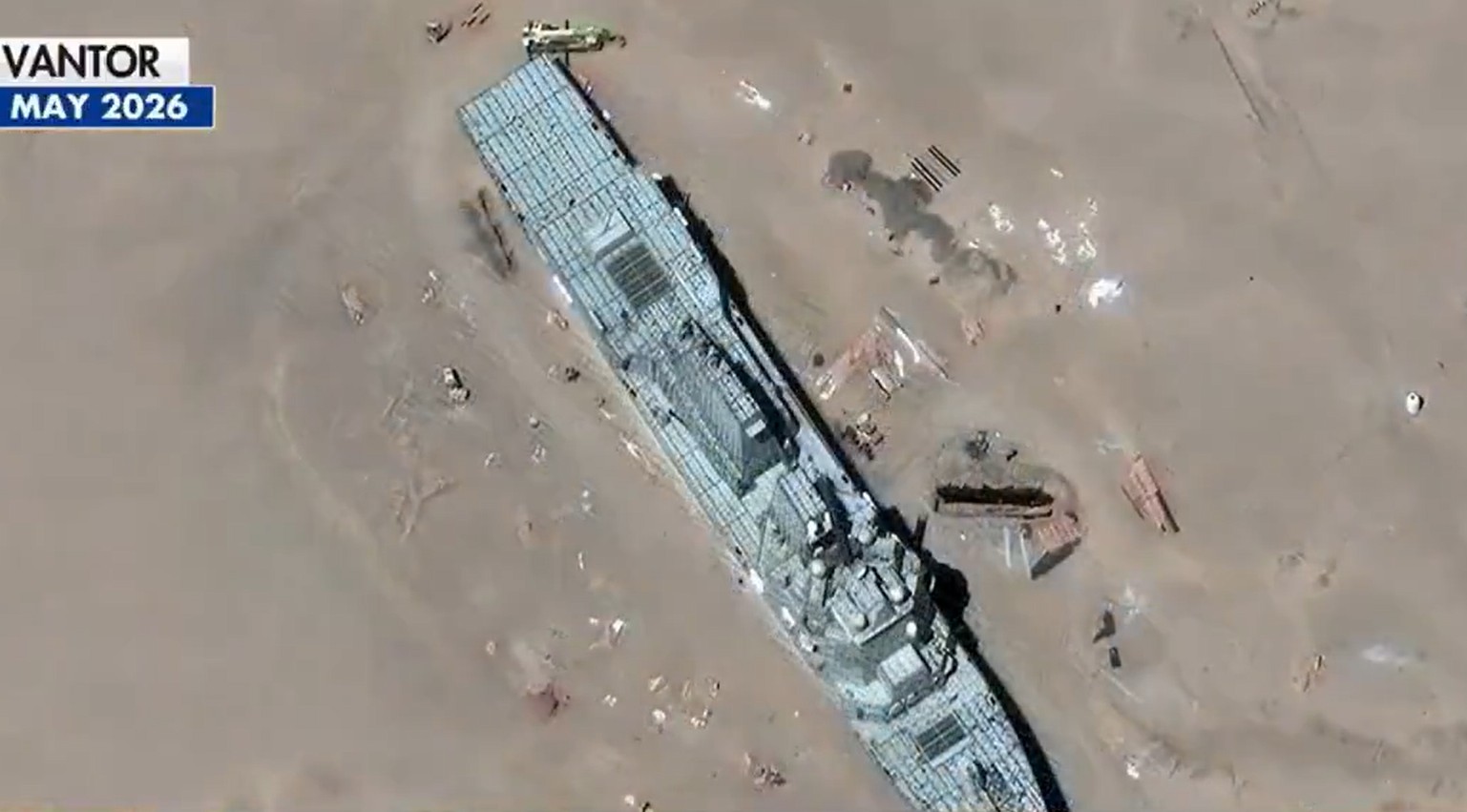

New satellite images appear to show that China has taken another significant step in preparing for a potential military confrontation with the United States, and this time the target is impossible to mistake. According to newly published imagery, the Chinese military has constructed what defense analysts believe is a remarkably accurate full-scale replica of a U.S. Navy Arleigh Burke-class guided missile destroyer at a testing facility in the remote Taklamakan Desert in Xinjiang.
The mock warship reportedly measures roughly 510 feet long, closely matching the dimensions of the real vessel. Unlike earlier replicas that only vaguely resembled American ships, this version appears to include an exact copy of the bridge, superstructure, helicopter landing deck, deck gun positions, mast arrangement, and other distinctive features that define one of the U.S. Navy’s most capable surface combatants.
American satellite company Vantor reportedly monitored the construction over the past six months, documenting the gradual appearance of the structure. The level of detail has caught the attention of military experts, many of whom believe this replica was built for far more than simple training exercises.
Defense analysts say one likely purpose is helping the People’s Liberation Army improve the targeting capabilities of its growing arsenal of anti-ship weapons. Modern missiles, drones, and AI-assisted guidance systems increasingly rely on image recognition technology to identify specific classes of warships before striking. Training against an accurate replica could allow those systems to better distinguish an Arleigh Burke destroyer from other vessels sailing as part of a U.S. carrier strike group.
Some experts believe the mock-up could also support testing of China’s DF-21D and DF-26 anti-ship ballistic missiles, often referred to as “carrier killers” because they were specifically designed to threaten large American naval formations operating throughout the Indo-Pacific. Others suggest the replica could assist with evaluating satellite surveillance systems, drone reconnaissance capabilities, or advanced missile guidance technology that requires realistic targets during development.
This is hardly the first time China’s military activities in its western deserts have raised eyebrows. In 2021, satellite imagery revealed replicas of U.S. aircraft carriers, destroyers, and other military facilities believed to be connected to weapons testing and battlefield simulations. Those discoveries fueled concerns that Beijing was actively rehearsing strikes against high-value American military assets in the event of a conflict over Taiwan or elsewhere in the region.
The latest discovery arrives as China continues expanding its navy, missile forces, cyber capabilities, and space-based surveillance network. That rapid military modernization has become a growing concern for defense planners who view the Indo-Pacific as one of the world’s most strategically important regions.
Some analysts argue the replica serves another purpose beyond testing weapons. Because the structure is enormous and easily visible in commercial satellite imagery, they believe Beijing may be intentionally sending a message to both Washington and Taipei. Displaying a detailed copy of one of America’s premier warships suggests China wants the world to know it is preparing for the possibility of direct confrontation with U.S. naval forces.
Analysts have pointed to previous Chinese facilities containing replicas of Taiwan’s presidential palace as another example of military training that also functions as political signaling. Whether these mock targets are intended primarily for weapons development, strategic messaging, or both remains a matter of debate.
China has not publicly commented on the newly released satellite images or acknowledged the purpose of the destroyer replica. Even so, defense experts say its realistic design, remote testing location, and connection to China’s expanding anti-ship capabilities strongly indicate the structure was built to support military planning against some of the U.S. Navy’s most advanced warships. As tensions continue to rise across the Indo-Pacific, developments like these are likely to receive even closer scrutiny from American defense officials in the months ahead.
Leave a Comment