
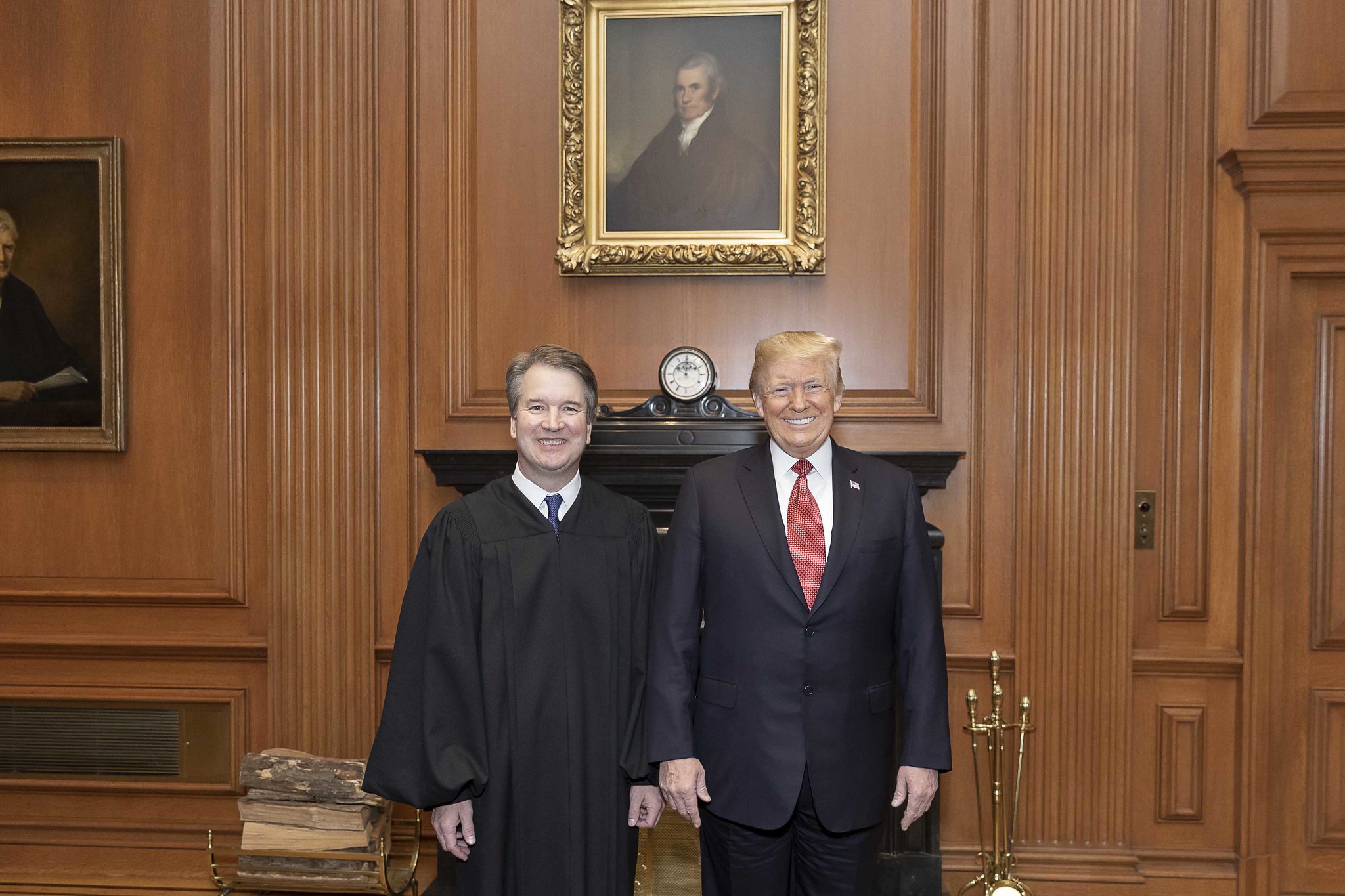

President Trump is already looking beyond his recent Supreme Court loss on birthright citizenship, and according to comments from both the president and Justice Brett Kavanaugh’s opinion in Trump v. Barbara, there may be a legislative path forward that avoids the far more difficult process of amending the Constitution.
The issue centers on Executive Order 14160, signed by President Trump on January 20, 2025. The order sought to limit automatic birthright citizenship for certain children born in the United States. Specifically, it applied to children born to mothers who were either unlawfully present in the country or present only temporarily, such as on visas, when the father was neither a U.S. citizen nor a lawful permanent resident.
On June 30, the Supreme Court struck down the order in a 6-3 ruling. Chief Justice John Roberts authored the majority opinion, joined by Justices Sonia Sotomayor, Elena Kagan, Amy Coney Barrett, and Ketanji Brown Jackson. By a narrow 5-4 margin on the constitutional question, the Court concluded that the order violated the Citizenship Clause of the Fourteenth Amendment.
The majority reaffirmed the longstanding interpretation that children born in the United States are generally citizens at birth, including those whose parents are unlawfully or temporarily present in the country. The Court pointed to precedent, including the 1898 case United States v. Wong Kim Ark.
However, buried within the ruling was a significant opening that has quickly caught President Trump’s attention.
Justice Brett Kavanaugh agreed that the executive order could not stand, but for a very different reason. Rather than finding it unconstitutional, Kavanaugh argued that the order conflicted with existing federal law, specifically 8 U.S.C. § 1401(a). In his view, Congress has the authority to change that law and establish exceptions to birthright citizenship if it chooses to do so.
Kavanaugh wrote that Congress could amend the statute or pass new legislation creating exceptions for children born to foreign citizens who are unlawfully or temporarily in the United States. He stated that such legislation could be consistent with the Fourteenth Amendment.
That distinction is critical.
Instead of pursuing another executive order that would almost certainly face immediate legal challenges, President Trump is now pointing toward Congress as the vehicle for change. In a Truth Social post following the ruling, he argued that lawmakers could address the issue through legislation and emphasized that a constitutional amendment would not be necessary.
At a rally in Medora, North Dakota, President Trump expanded on that argument, stating that birthright citizenship was never intended to encourage birth tourism or provide automatic citizenship benefits to individuals who enter the country temporarily. He also referenced the historical origins of the Fourteenth Amendment in the post-Civil War era.
The White House has signaled that the administration remains committed to pursuing policies aimed at protecting the value of American citizenship while continuing broader immigration enforcement efforts.
If Congress were to act, federal agencies would then be able to update policies governing passports, Social Security numbers, birth documentation, and other citizenship-related records based on the new law. That would place the policy on a statutory foundation rather than relying solely on executive authority.
Of course, any such legislation would almost certainly face another round of court challenges. The Supreme Court’s narrow 5-4 split on the constitutional question demonstrates that there is still significant disagreement among the justices. Future cases, and potentially future changes in the Court’s composition, could ultimately determine whether Congress has the authority that Justice Kavanaugh believes it does.
For now, President Trump appears to see the ruling not as the end of the fight, but as a roadmap for the next phase. The executive order may be gone, but the debate over birthright citizenship is clearly far from over.
Leave a Comment