
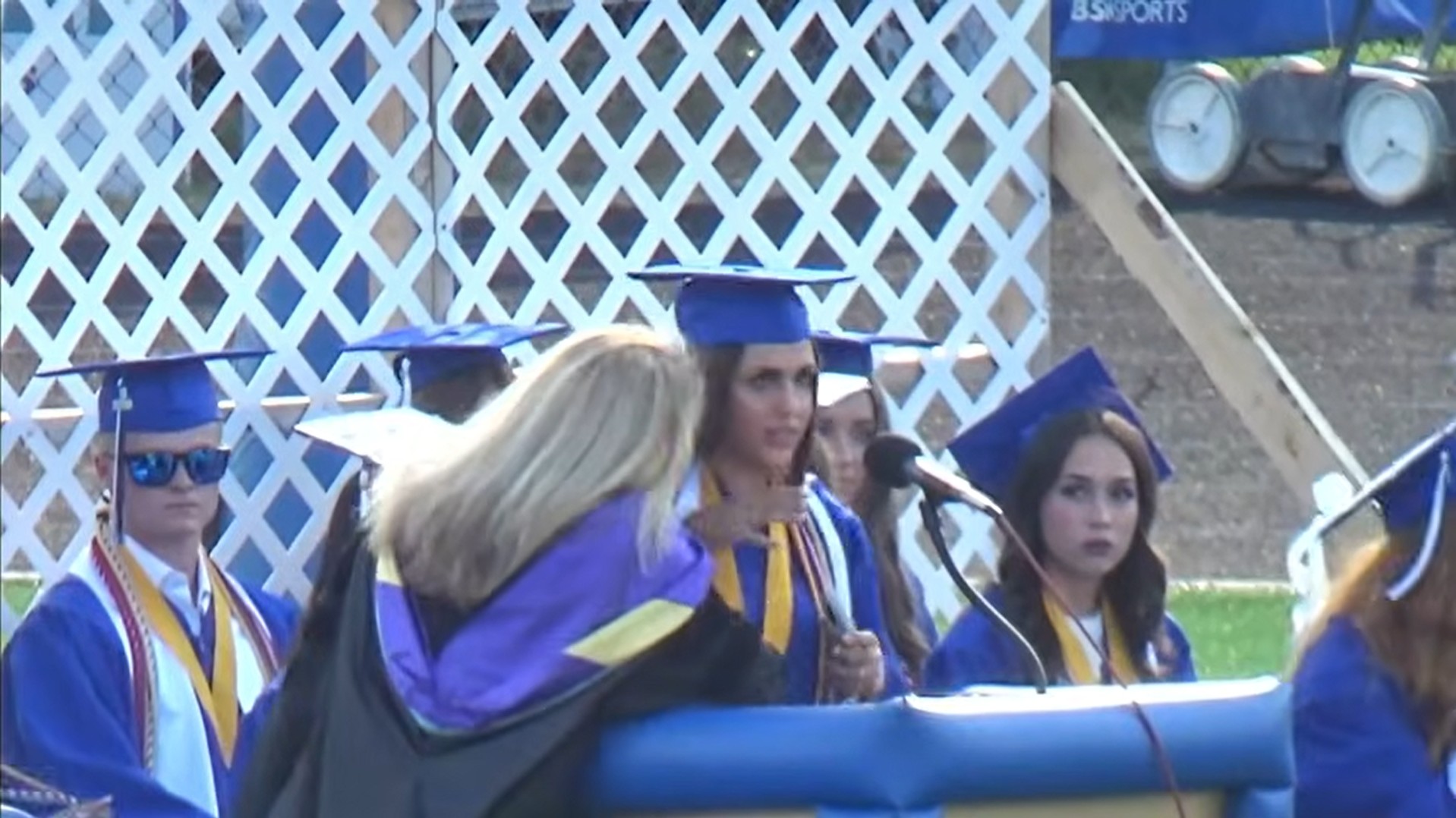

A North Carolina high school principal is receiving praise from many parents and community members after intervening during a graduation ceremony when a student abandoned her approved remarks and launched into a political speech.
The incident occurred during Clayton High School’s commencement ceremony, where valedictorian Leen Hijaz had been selected to address her fellow graduates because of her academic achievements. Like most graduation speeches, the expectation was that her remarks would focus on the accomplishments of the graduating class, future aspirations, and words of encouragement for classmates.
Instead, Hijaz reportedly departed from the speech that had been reviewed and approved by school officials.
Near the conclusion of her address, Hijaz shifted into political commentary, discussing issues involving Palestine, Sudan, Congo, Afghanistan, and immigration enforcement in the United States.
“Before I leave the stage, I have one last thing to say,” Hijaz began. “Every single person here has a voice; we have the privilege to use it when millions around the world are struggling and suffering to be heard.”
She continued by referencing “millions suffering in Palestine” and criticized Immigration and Customs Enforcement, commonly known as ICE, claiming families were being torn apart.
However, before she could continue much further, Clayton High School Principal Melissa Moore stepped onto the stage and removed the microphone, ending the speech and escorting the student away from the podium.
The moment quickly spread across social media, where reactions were sharply divided. Some activists praised Hijaz for attempting to use the platform to advocate for causes she believes in. Others argued that graduation ceremonies are not the appropriate venue for political activism, particularly when speakers have agreed to deliver pre-approved remarks.
School officials made their position clear shortly after the event.
In a statement, Johnston County Public Schools explained that administrators intervened because the student had departed from her approved speech. The district emphasized that the decision was not intended to silence anyone’s views but rather to preserve the purpose of the ceremony.
“School administrators intervened in order to maintain the integrity and focus of the program in real time,” the district stated. “This action was not about limiting a student’s voice, but about ensuring that a school-sponsored event remained consistent with its intended purpose.”
That distinction is important. Graduation ceremonies are designed to celebrate students, families, teachers, and years of hard work. They are not political rallies. Students are free to express their opinions through countless other channels, including social media, public demonstrations, and community events.
Hijaz later complained on social media that she was unable to finish her speech and suggested she felt “oppressed” by the intervention.
Critics of that argument note that she was given one of the highest honors a school can bestow, the opportunity to address her graduating class. They argue that with that privilege comes a responsibility to respect the agreed-upon guidelines for the event.
For many observers, Principal Moore’s decision demonstrated a simple principle: when a speaker disregards the rules of a school-sponsored event, administrators have every right to enforce them.
Leave a Comment