
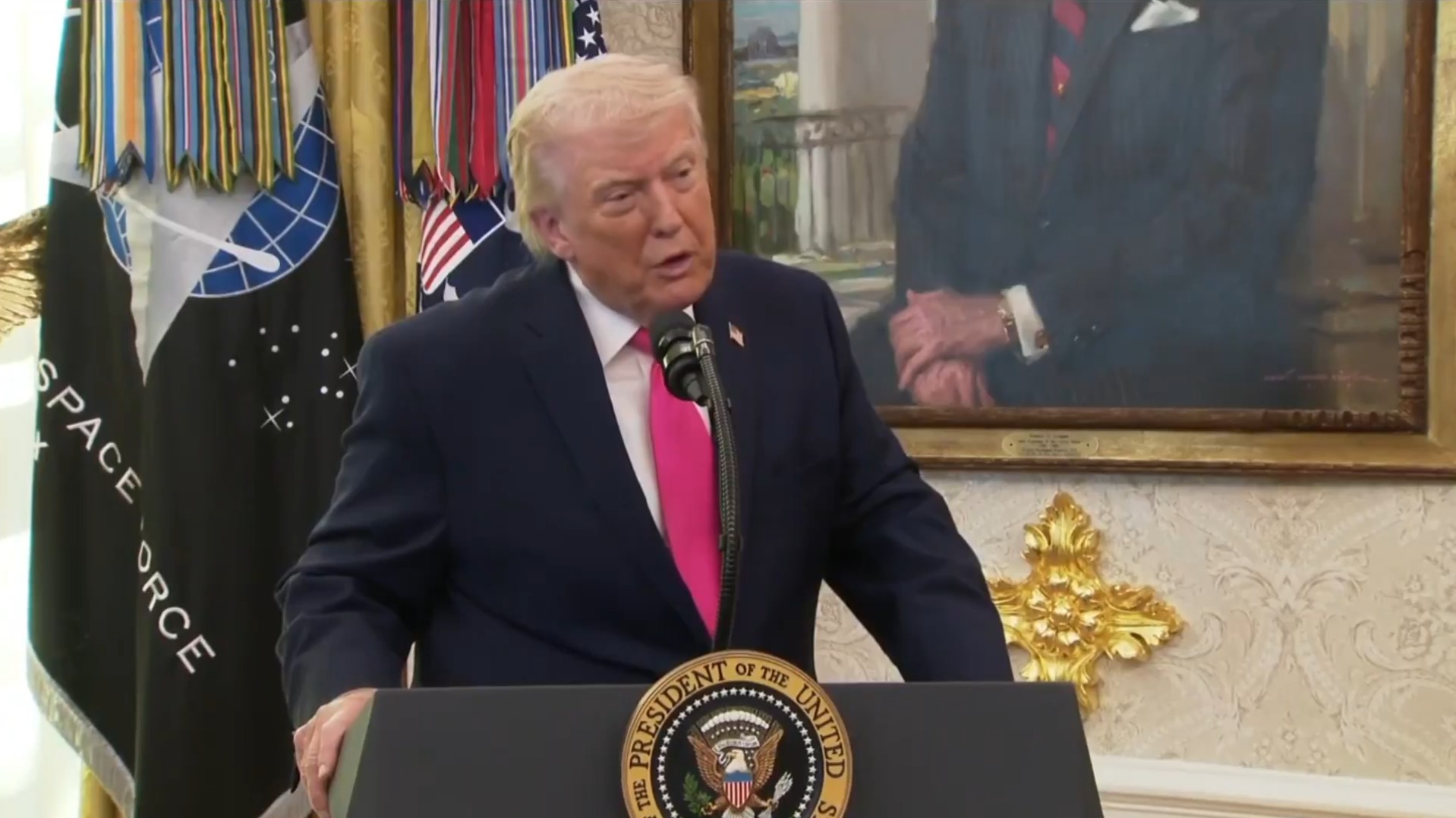

President Trump delivered an unmistakable message Wednesday about the role of Sharia law in America: the United States has one legal system, and he intends to keep it that way.
During a live interview with conservative radio host Glenn Beck, President Trump was asked directly whether he would support or sign legislation prohibiting Sharia law in the United States.
His answer wasn’t exactly buried beneath three paragraphs of Washington legalese.
“Number one, on Sharia law, I would absolutely say that’s not this country. There’s no Sharia law. And you do have pockets of it, as you know,” President Trump said.
President Trump then pointed to Europe, specifically London and Paris, as examples of what he believes the United States should avoid.
“And you go to London, you go to Paris. It’s almost like a second way of life. It’s ridiculous,” he said.
President Trump framed his position as a matter of common sense rather than ideology.
“You and I have people that I think we’re more based on common sense than we are in ideology,” he told Beck. “Good politics is all about common sense anyway.”
Then came the statement likely to generate plenty of political and legal debate.
“But I would absolutely prohibit the Sharia law thing,” President Trump said. “And it is happening in this country a little bit. And when we see it, we take it out. And you have to take it out.”
He concluded by emphasizing the principle behind his position.
“You have one system. We have a great system. Sometimes it’s very frustrating. But it’s the best there is that I can see.”
That distinction matters because American constitutional law already establishes the supremacy of federal and state law. Religious rules cannot simply override the Constitution or applicable statutes.
At the same time, Americans possess broad First Amendment protections allowing them to practice their religions voluntarily. Muslims, Christians, Jews and members of other faiths can organize their personal lives around religious teachings, provided doing so doesn’t supersede controlling American law or violate other people’s legal rights.
So any federal proposal aimed specifically at Sharia would inevitably raise constitutional questions involving both the Free Exercise and Establishment Clauses. The details of any actual legislation would matter enormously.
The political argument, however, is already heating up.
Sharia has become an issue in Michigan’s U.S. Senate race, where Democrat Abdul El-Sayed is facing Republican Mike Rogers. Republicans have criticized El-Sayed over previous comments regarding attempts to prohibit courts from considering Sharia law.
El-Sayed’s campaign has also confirmed that he personally follows Sharia principles in his religious life, including previously obtaining a Sharia-compliant mortgage. His campaign maintains that personal religious observance is entirely different from attempting to impose religious law through government.
That distinction deserves to remain clear. Americans have a constitutional right to practice their faith. They do not have a right to replace American civil or criminal law with a separate compulsory religious legal system.
President Trump’s comments put that basic question squarely into the 2026 political conversation.
America’s constitutional system can protect religious liberty while simultaneously insisting that government operates under one body of law.
As President Trump put it, “You have one system.”
For a country governed by a Constitution rather than competing religious codes, that is going to be a powerful argument.
Leave a Comment