
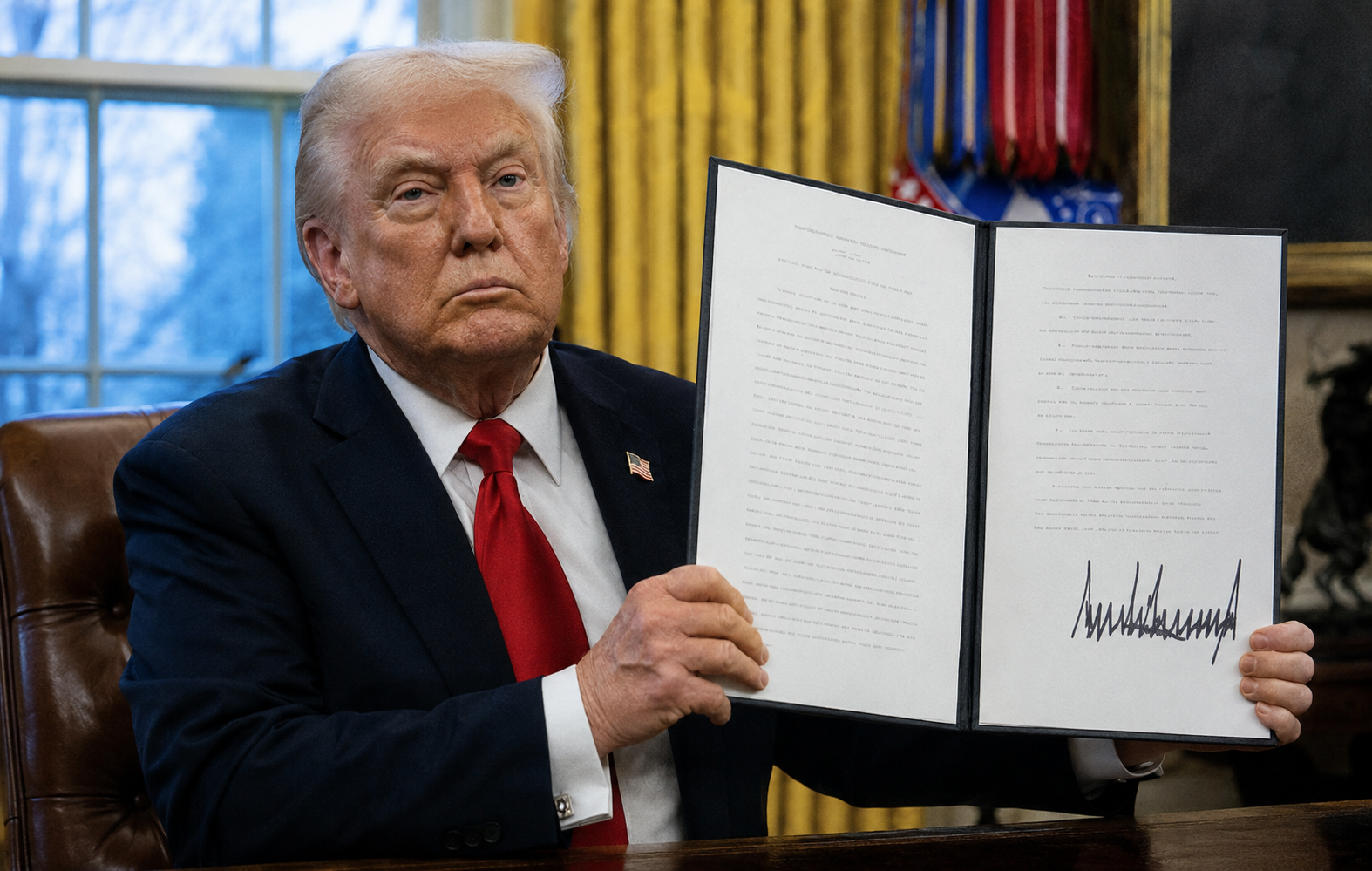

President Trump signed an executive order Thursday directing the federal government to refer to Lake Ontario as “Lake America,” adding another unmistakably Trump-style name change to the federal map.
The order, signed August 27 at the Resolute Desk in the Oval Office, directs Interior Secretary Doug Burgum to update the Geographic Names Information System. That system works alongside the U.S. Board on Geographic Names to standardize geographic terminology used throughout the federal government.
“We’re going to be changing the name of Lake Ontario, effective immediately, to Lake America,” President Trump said before putting pen to paper.
There was not much ambiguity about the message. Maps displayed behind President Trump already showed the lake labeled “Lake America,” accompanied by the slogan “MAKING THE GREAT LAKES EVEN GREATER.”
Subtle? Not particularly. But nobody has ever accused President Trump of treating a naming announcement like a sleepy bureaucratic paperwork exercise.
There is an important limitation to the order. Washington can determine what American federal agencies call the lake, but it cannot force Canada or international organizations to follow along. The international boundary runs directly through the lake, and approximately 53 percent of its waters are on the Canadian side.
“The Americans can call it whatever they want to call it. It is Lake Ontario,” Canadian maritime attorney Marc Isaacs said in a statement to NBC News.
That disagreement could produce the unusual situation in which American federal documents and maps identify the body of water as Lake America while Canadian authorities continue calling it Lake Ontario.
The International Hydrographic Organization does not provide an easy referee for the dispute. Although both the United States and Canada are members, the organization primarily deals with hydrographic surveying and nautical charting rather than possessing authority to dictate the names of shared inland waters.
President Trump had previewed the move two days earlier on Truth Social.
“The United States is giving serious consideration to changing the name of Lake Ontario to Lake America in that we don’t expect to doing much business with Ontario any longer. Thank you for your attention to this matter,” President Trump wrote.
He subsequently posted a map showing “Lake Ontario” crossed out and “Lake America” written over it in gold.
The timing makes the executive order considerably more than a geography lesson.
The United States and Canada are locked in another trade confrontation following the breakdown of negotiations last week. The United States imposed 50 percent tariffs on $20 billion worth of Canadian goods. Canada responded with matching retaliatory tariffs covering $20 billion in American products, including steel, dairy products, appliances and farm equipment.
Against that backdrop, “Lake America” functions as both a federal naming decision and a rather large, watery message to America’s northern neighbor.
Lake Ontario is the smallest of the five Great Lakes by surface area and sits between New York and the Canadian province of Ontario. Its familiar name has centuries of history behind it. “Ontario” derives from an Iroquoian term commonly rendered as “oniatarí:io,” translated as “lake of shining waters” or “great lake.” European maps were using the name by the middle of the 17th century, and the Canadian province established in 1867 subsequently took its name from the lake.
That history is not disappearing because of an American executive order. Canadians can continue saying Lake Ontario, international organizations can continue using their preferred terminology, and arguments over maps will undoubtedly keep cartographers and politicians occupied.
Inside the U.S. federal government, however, President Trump has made his preference official.
Lake Ontario has centuries of history behind its name. Lake America now has a presidential signature behind its own.
And somewhere in Ottawa, somebody is probably staring at that gold-lettered map and reaching for another cup of coffee.
Leave a Comment