
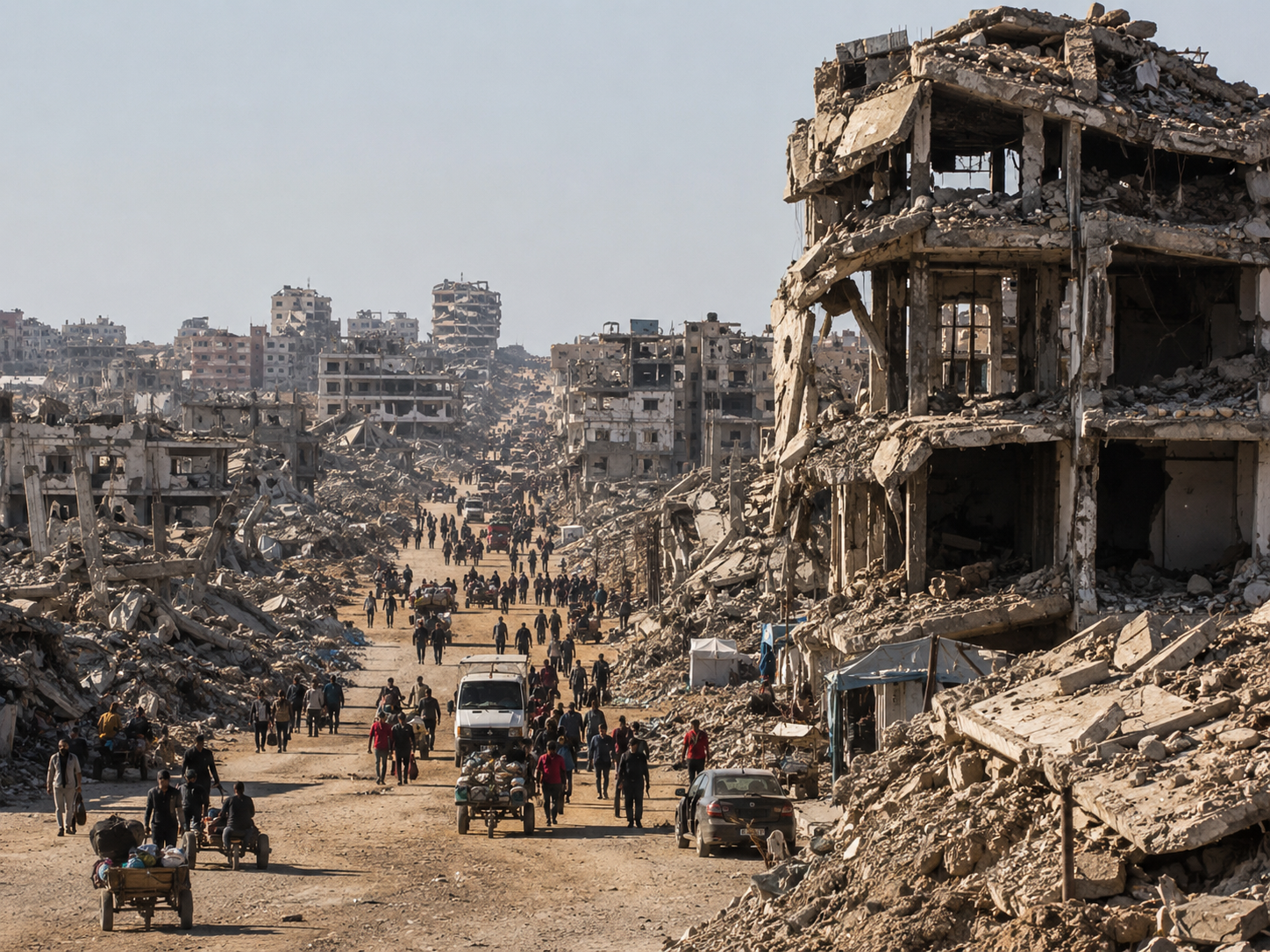

President Trump announced what he described as a major diplomatic breakthrough Thursday night, unveiling a proposed agreement that would fundamentally reshape Gaza’s security structure by requiring Hamas and all other armed groups to surrender their weapons as the central condition for moving toward peace.
According to President Trump, the agreement was negotiated through his administration’s Board of Peace with the assistance of mediators from Qatar, Egypt, and Turkey. If ultimately implemented, the proposal would pair the verified disarmament of Hamas with a phased Israeli military withdrawal and the creation of a new Palestinian governing authority supported by an international stabilization force.
Unlike previous ceasefire proposals that largely focused on halting fighting, the framework announced by President Trump centers on one requirement that supporters argue cannot be negotiated away or indefinitely postponed: complete demilitarization.
Under the proposal, Hamas would be required to surrender both heavy and light weapons, disclose the locations of tunnel networks, weapons-production sites, and arms depots, and relinquish any armed control over Gaza.
Only after those steps are independently verified would Israeli forces begin withdrawing in phases.
President Trump outlined the proposal on Truth Social, calling it a significant step toward achieving lasting peace and regional security. He said the long-term objective is to establish a single government, one legal system, and one legitimate security authority inside Gaza, replacing competing militant organizations with civilian institutions responsible for maintaining order.
According to details that have emerged about the proposal, a temporary Palestinian technocratic government would oversee public services during the transition. A newly vetted Palestinian police force would gradually assume responsibility for local security, operating alongside an International Stabilization Force as areas are transferred from Israeli military control.
Reports indicate the disarmament process would likely take six to eight months to complete. During that time, Hamas would reportedly provide maps identifying tunnels, weapons factories, and storage facilities while transferring its weapons into secured storage under the supervision of the new governing authority.
The proposal also reportedly includes provisions under which Hamas members who fully comply with the disarmament process and renounce violence could become eligible for amnesty. Armed groups outside Hamas would likewise be required to disband under the framework.
According to reports, U.S. officials have indicated that Hamas has agreed to the proposed terms. However, Israeli officials and several Western diplomats have reportedly expressed skepticism, citing Hamas’ history of failing to fully implement previous agreements and continuing to maintain military capabilities during past negotiations.
That skepticism means the success of the proposal will likely depend less on announcements than on measurable actions.
Observers say any agreement of this scope would ultimately be judged by whether weapons are actually surrendered, tunnel systems are dismantled, militant infrastructure is eliminated, and security responsibilities are successfully transferred to civilian authorities.
The framework closely resembles the administration’s broader Gaza peace plan introduced last year, which also called for Hamas to relinquish governing authority, permanently surrender its weapons under international monitoring, destroy military infrastructure, and link any Israeli withdrawal directly to verified security milestones.
If the agreement moves forward, it would represent one of the most ambitious attempts to restructure Gaza since the conflict began. Much work remains before any proposal becomes reality, and implementation would require sustained cooperation among multiple governments, international organizations, and parties that have spent years locked in conflict.
For now, President Trump has presented the framework as a roadmap toward a post-war Gaza built around civilian governance rather than armed factions. Whether that vision ultimately becomes reality will depend on what happens on the ground in the weeks and months ahead, particularly during the verification process that both supporters and skeptics agree will determine the agreement’s credibility.
Leave a Comment