

A federal judge just handed New York a major legal defeat over its attempt to stick fossil fuel companies with a $75 billion climate bill, and the ruling raises a pretty basic constitutional question: How far can one state go when it decides to regulate a problem that crosses every state line and national border on the planet?
On Monday, U.S. District Judge Brenda Sannes ruled that New York cannot enforce its Climate Change Superfund Act, formally known as the Climate Change Adaptation Cost Recovery Program.
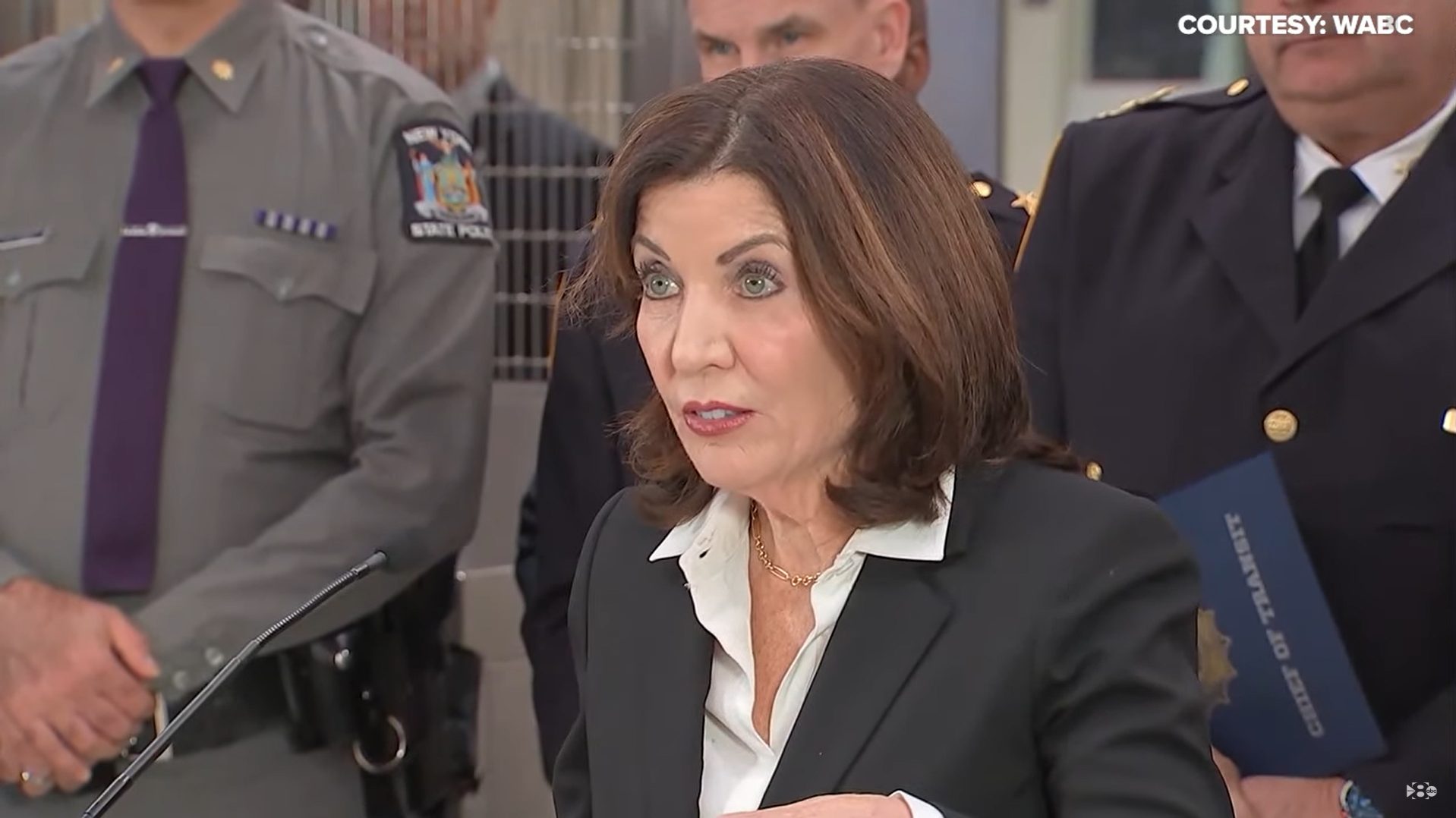
The law, signed by Gov. Kathy Hochul on December 26, 2024, was built around the fashionable “polluter pays” concept. New York planned to identify fossil fuel companies associated with more than 1 billion tons of greenhouse gas emissions between 2000 and 2018, then require those companies to collectively cough up $3 billion every year beginning in 2028.
Do the math and you arrive at a staggering $75 billion over 25 years.
The money was supposed to finance infrastructure projects involving roads, sewage systems, stormwater drainage, public transit, the electrical grid, coastal protections and extreme-heat mitigation. Companies would have been charged according to their proportional share of emissions among the businesses designated responsible by the state.
There was a rather important catch. Companies did not have to be found guilty of violating environmental laws when those historical emissions occurred. New York essentially wanted to look backward, calculate emissions associated with past lawful business activity, assign companies a share of future climate adaptation costs, and send them the bill.
Apparently, federalism still exists.
Sannes concluded that the Clean Air Act, which gives the Environmental Protection Agency authority over greenhouse gas emissions, does not give individual states a green light to establish sweeping emissions compensation programs like New York’s.
“The Climate Act is an unusual and sweeping statute, designed to address the effects of climate change–a ‘uniquely international problem of national concern,’” Sannes wrote. “Thus, the Court finds the Climate Act is ‘simply beyond the limits of state law.’”
She wasn’t finished.
“It is precisely because the Climate Act operates within an area of law in which the federal interest is so dominant that it cannot be enforced.”
That gets directly to the problem with Albany’s approach. Climate change is, by definition, not confined to New York. Carbon dioxide doesn’t reach the Pennsylvania border, see the welcome sign and politely turn around. Trying to make selected companies finance one state’s climate agenda based on worldwide historical emissions creates obvious questions about interstate commerce, federal authority and foreign affairs.
Sannes also ruled that efforts to extract payments from foreign producers were preempted under the foreign affairs doctrine. Her decision relied partly on the Second Circuit’s 2021 ruling in City of New York v. Chevron Corp., another significant defeat for efforts to use state-level legal theories against energy producers over global climate effects.
The challenge was brought in February 2025 by 22 states led by West Virginia, joined by industry organizations including the U.S. Chamber of Commerce, American Petroleum Institute and National Mining Association. The Justice Department subsequently backed the plaintiffs.
The larger issue isn’t whether governments can build stronger roads, improve drainage or protect coastal infrastructure. They obviously can. The question is whether New York can create what amounts to a massive retroactive climate invoice and distribute it among companies based on historical emissions, including emissions connected to activity outside New York and abroad.
For now, the federal court’s answer is no.
New York officials say they are exploring their options, so this legal battle may continue. But Albany’s $75 billion climate collection scheme has hit a rather substantial obstacle called federal law.
Leave a Comment