
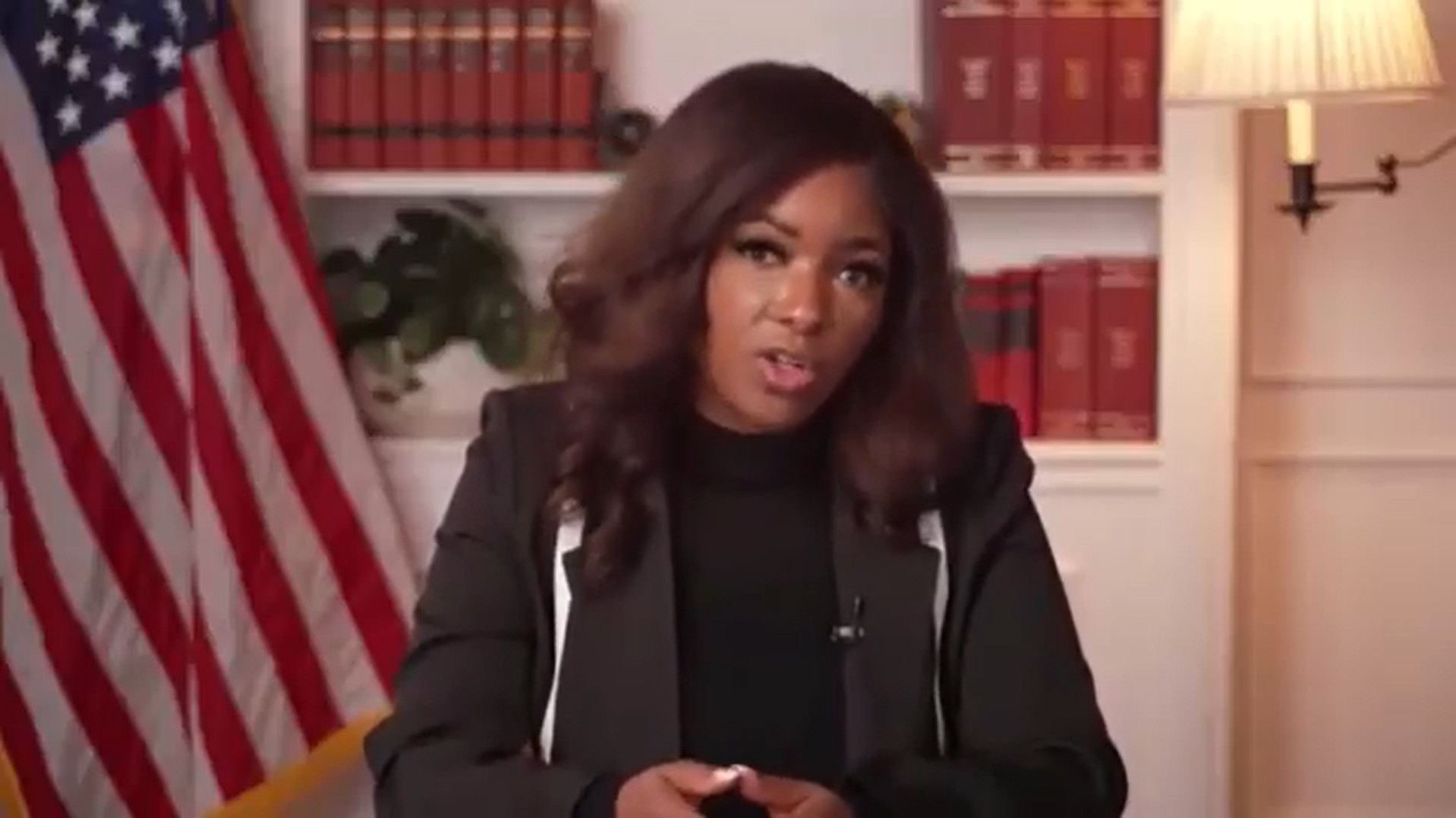

Outgoing U.S. Rep. Jasmine Crockett (D-TX) is drawing fierce criticism after comments she made on her podcast, “Clock It With Crockett,” in which she defended convicted murderer Karmelo Anthony and appeared to suggest that she would have acted similarly under the circumstances. The remarks came just hours after a Collin County jury found Anthony guilty of murdering 17-year-old Austin Metcalf during a track meet in Frisco, Texas.
The case has attracted national attention because of the shocking nature of the crime and the conflicting narratives that emerged in its aftermath. According to testimony presented during the trial, Anthony was sitting under a rival school’s tent and repeatedly refused requests to leave. Witnesses testified that he was asked more than a dozen times to move but remained in place, escalating tensions with students from the opposing school.
Jurors heard testimony from more than a dozen witnesses, many of whom described Anthony as the aggressor in the confrontation. After a brief dispute, Anthony retrieved a knife from his backpack and stabbed Metcalf in the chest. Witnesses stated that Metcalf had indicated he did not want to fight and that the physical contact preceding the stabbing amounted to little more than a shove.
Following roughly three hours of deliberations, the jury returned a guilty verdict. Anthony was subsequently sentenced to 35 years in prison and will be eligible for parole after serving half of that sentence.
Instead of focusing on the jury’s findings, Crockett used her podcast to defend Anthony’s actions. In doing so, she described a hypothetical scenario in which a 300-pound man was “on top of me and beating me down,” arguing that a person in such circumstances would not be limited to defending themselves with their fists. Critics immediately pointed out that no such scenario was presented during the trial and that witness testimony did not support her characterization of events.
Crockett further argued that Metcalf’s size and status as a football player could be viewed as factors that justified fear. Her comments were widely interpreted as an attempt to recast the confrontation into a self-defense case despite the jury’s conclusion that Anthony committed murder.
The congresswoman’s remarks became even more controversial when she shifted the discussion to race. Crockett suggested that the Metcalf family could never understand the “fear and agony” experienced by black mothers raising black sons. While discussing broader racial issues, she contrasted those experiences with what she implied was a lack of similar hardship for the Metcalf family.
She also claimed that Anthony had been judged by “12 white folks,” despite reports indicating that the jury was not entirely white. Critics accused Crockett of spreading misinformation and attempting to undermine the legitimacy of the verdict by framing it through a racial lens.
For many observers, the most troubling aspect of Crockett’s comments was not simply her criticism of the justice system, but her willingness to defend the actions of a convicted killer while appearing to dismiss the loss suffered by the Metcalf family. The reaction has fueled renewed scrutiny of political rhetoric and raised questions about whether elected officials should be using their platforms to justify violence after a jury has already weighed the evidence and rendered its verdict.
Leave a Comment