
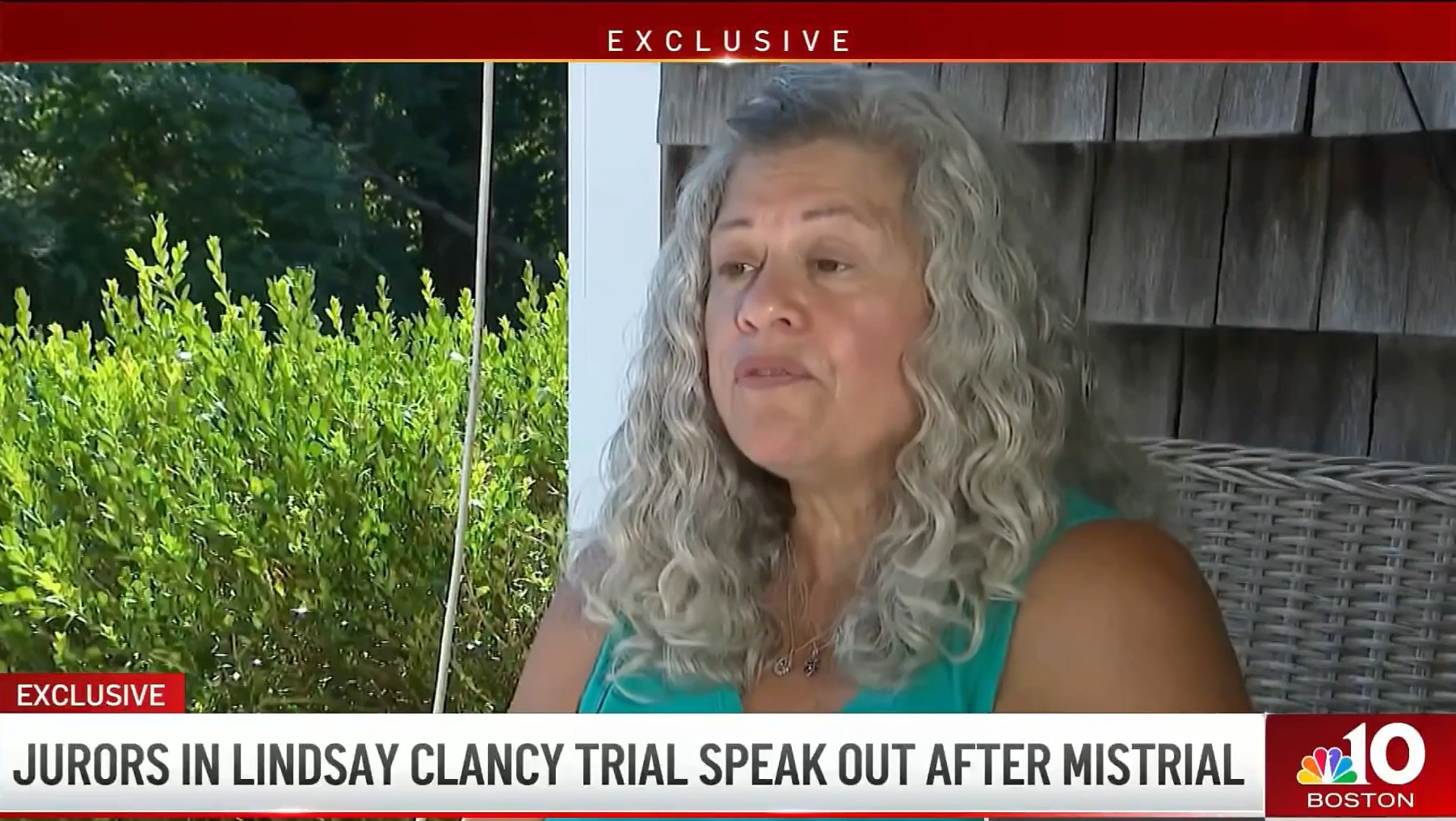

Three jurors from the Lindsay Clancy murder trial are speaking publicly after an extraordinary 11-1 deadlock ended one of Massachusetts’ most closely watched criminal cases in a mistrial.
The mistrial was declared September 4 after the Plymouth Superior Court jury, made up of nine women and three men, deliberated for roughly 38 hours over seven days without reaching a unanimous verdict.
Clancy, a former labor and delivery nurse, was charged with murder in connection with the January 2023 deaths of her three children, Cora, 5, Dawson, 3, and Callan, 8 months, at the family’s Duxbury home. Her defense maintained that Clancy was not criminally responsible because she was suffering from severe mental illness, including postpartum psychosis.
Now, interviews with jurors are providing a remarkable look inside the deliberation room and revealing just how close the panel came to reaching a verdict.
Three female jurors spoke with NBC10 Boston, including foreperson Ronnie, a retired fifth-grade special needs teacher, Kelly, a retired chef from Plymouth, and Paula, who had worked for government contractors.
According to Ronnie, the lone holdout at one point acknowledged having reasonable doubt, prompting her to believe the jury had finally reached agreement.
“He admitted he had reasonable doubt and I started filling out the forms, I was so excited,” Ronnie said. “There were three forms I had to fill out and I started filling them out. I wrote my signature on each one and then he said, ‘But I’m still not going to say that she’s not guilty by reason of insanity.’”
That apparently brought the process right back to square one.
One interviewed juror described the holdout as “arrogant,” saying, “He really did not take anything that anybody said.”
The jurors said nurses serving on the panel examined records from South Shore Hospital and a toxicology report involving Clancy’s medications. According to one juror, the holdout “just completely disregarded the information that they gave him.”
Another juror said he struggled to move beyond “the fact that Lindsay viciously killed her children.”
The three women also described heated deliberations that became loud enough for alternate jurors nearby to hear. They nevertheless said the panel continued trying to reach unanimity.
A separate juror, identified only as juror No. 5, offered WBZ-TV a somewhat more nuanced account of the disagreement. She said the prosecution’s case contained substantial uncertainty.
“At the end of the day, there was so much doubt. The prosecution didn’t have a figurative smoking gun,” she said. “There was too much gray area.”
Juror No. 5 said she initially believed Clancy was criminally responsible, but the evidence concerning her mental condition complicated that conclusion.
“I think that this is a woman who was not mentally healthy. She was someone who was in the throes of a significant mental health crisis.”
She also cautioned against placing all responsibility for the deadlock on the lone holdout.
“The stand-alone juror was not the only one that was unwilling to see things from the other side,” she said. “There were some big personalities in that room. But at the end of the day, it just came down to an inability to move past your convictions.”
That distinction matters. Jury deliberations are supposed to be difficult in cases involving disputed criminal responsibility, and unanimity is required for a verdict. An 11-1 split can look tantalizingly close from outside the courthouse, but legally, close does not count.
The mistrial leaves the prosecution with a major decision. Prosecutors have not yet announced whether they will retry Clancy, meaning the deeply emotional case could eventually return to another courtroom, with another jury being asked to wrestle with the same difficult question of criminal responsibility.
Leave a Comment