
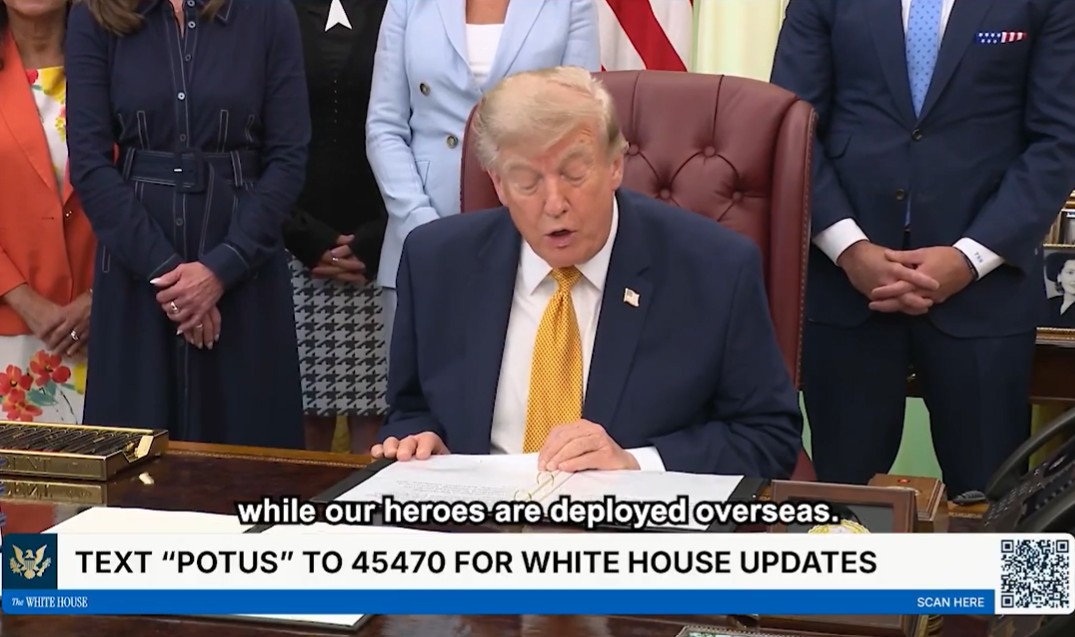

President Trump signed a new executive order Monday creating the first-ever President’s Military Spouse Commission, but it was his remarks immediately afterward about Iran that quickly became the headline.
Speaking from the Oval Office, President Trump announced the new advisory commission before shifting to the escalating situation in the Middle East, where he said negotiations with Iran were underway and warned that Tehran was facing what he described as its “last chance” to reach an agreement.
“We are talking about the opening of the Strait by tomorrow,” Trump told reporters, referring to the Strait of Hormuz, one of the world’s most strategically important shipping lanes. He said reopening maritime traffic would represent the first phase of a broader agreement, with a second phase focused on eliminating Iran’s nuclear capabilities.
The president also revealed that the United States had been prepared to carry out what he described as the largest military strike since World War II before choosing to give diplomacy another opportunity. According to Trump, officials from Saudi Arabia, the United Arab Emirates, and Qatar urged him to delay military action and allow negotiations to continue.
While much of the attention centered on Iran, the executive order signed earlier in the event focused on military families.
President Trump called the creation of the President’s Military Spouse Commission “long overdue,” saying military spouses have spent decades dealing with challenges that often receive little attention despite their impact on readiness and morale.
The commission will serve as an advisory body tasked with identifying and recommending solutions for issues affecting military families. Among its priorities are housing, employment opportunities, healthcare access, education, childcare, deployment support, and the professional licensing obstacles many military spouses face after frequent relocations.
Military families often move every few years as service members receive new assignments, disrupting careers, children’s education, healthcare providers, and financial stability. The administration says the new commission is intended to provide military spouses with a direct line to the White House so those recurring concerns can be addressed more effectively.
Under the executive order, the commission will gather feedback directly from military spouses and submit recommendations to the president through annual reports, followed by a final report before the commission concludes its work. The commission is scheduled to operate for two years unless extended.
Jennifer Hegseth, who will chair the commission, said she has spent the past year meeting military spouses both in the United States and overseas. According to Hegseth, the same concerns surfaced repeatedly regardless of location, including employment opportunities, childcare, healthcare, education, and the difficulty of transferring professional licenses between states.
Secretary of War Pete Hegseth said strong support for military families directly contributes to military readiness, arguing that service members perform best when they know their families are receiving the support they need at home.
Chairman of the Joint Chiefs Gen. Dan Caine echoed that message, describing military spouses as a vital part of America’s national defense by providing stability for families during deployments and frequent relocations.
The discussion then returned to Iran.
President Trump said negotiations were actively taking place and emphasized that diplomacy remained his preferred option. At the same time, he warned that military action remained available if negotiations failed.
According to Trump, the immediate objective is restoring normal shipping through the Strait of Hormuz before turning to the broader issue of Iran’s nuclear program.
Iran, however, has publicly characterized the discussions differently, saying talks have centered on maritime navigation through Oman rather than broader negotiations with the United States over nuclear issues.
Those differing descriptions underscore the uncertainty surrounding the diplomatic effort. While President Trump presented the discussions as the beginning of a comprehensive agreement, Iranian officials have offered a narrower public account.
For now, the administration is pursuing two very different priorities at once. One seeks to strengthen the families supporting America’s armed forces. The other aims to prevent a regional conflict through negotiations while making clear that the military option remains available if diplomacy ultimately fails.
Leave a Comment