
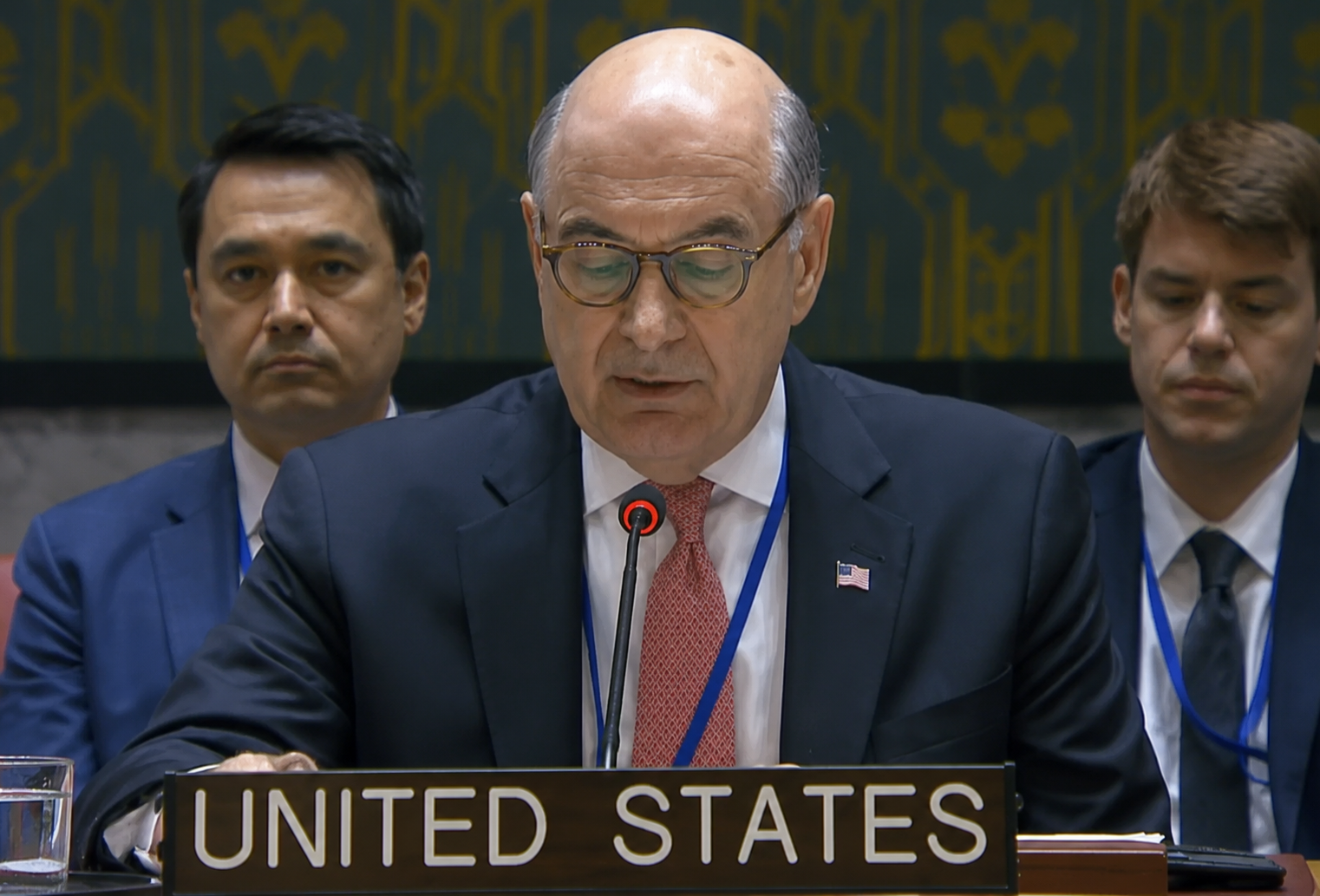

A rare diplomatic confrontation unfolded at the United Nations on Monday as the United States delegation staged a walkout during remarks by France’s ambassador, underscoring growing tensions between two longtime allies over human rights policy and the direction of the U.N.
The protest occurred during a United Nations Security Council meeting focused on Russia’s ongoing war in Ukraine. Rather than remain in the chamber while France delivered its statement, members of the U.S. delegation stood up and exited the room in a move American officials later confirmed was intentional.
The unusual demonstration was not related to France’s position on Ukraine but instead stemmed from an escalating dispute over the leadership of the United Nations’ top human rights office.
The disagreement began last week when the U.N. General Assembly voted on whether to grant U.N. High Commissioner for Human Rights Volker Türk another four-year term. The resolution passed comfortably, with 144 countries voting in favor. The United States was among only 10 nations that opposed the extension.
The Trump administration has argued that the Office of the High Commissioner for Human Rights has too often directed criticism toward democratic allies, including the United States and Israel, while failing to show the same level of scrutiny toward authoritarian governments with far worse human rights records.
Following the vote, France’s mission to the United Nations in Geneva publicly criticized Washington’s position. In a social media post, the French mission noted that the United States had voted alongside countries including Russia and North Korea against extending Türk’s term. The post went further by suggesting the United States was no longer serving as the world’s benchmark for defending human rights.
That criticism quickly prompted a response from U.S. Ambassador to the United Nations Mike Waltz, who accused France of defending a human rights office that, in his view, has demonstrated an uneven approach by frequently targeting democratic nations while failing to adequately confront some of the world’s most repressive regimes.
The dispute reached a boiling point during Monday’s Security Council meeting.
Before leaving the chamber, Dan Negrea, an alternate U.S. representative to the United Nations, explained the administration’s decision in unusually direct terms.
“There is a member of this council that will feign moral outrage and pretend to lecture the rest of us,” Negrea said.
He went on to accuse France of engaging in “disingenuous grandstanding” and spreading “politicized drivel,” adding that the United States would continue walking out during French interventions unless Paris changed what he described as its “condescending and disrespectful rhetoric.”
“That is why we walked out during France’s intervention,” Negrea stated.
France chose not to respond publicly during the meeting. Ambassador Jérôme Bonnafont proceeded with his prepared remarks on the war in Ukraine, emphasizing France’s continued support for Kyiv and reaffirming his country’s commitment to the principles of the United Nations. He made no reference to the American protest or the empty seats left behind by the departing U.S. delegation.
Walkouts inside the Security Council are relatively rare, particularly when they involve two permanent members that have historically cooperated on many major international issues. The five permanent members, the United States, France, the United Kingdom, China, and Russia, often disagree on policy, but public demonstrations of this nature between Washington and Paris are uncommon.
The incident also reflects the broader approach President Trump has taken toward international institutions during his administration. The White House has repeatedly argued that several U.N.-affiliated organizations have become increasingly politicized and have applied inconsistent standards when evaluating the conduct of democratic governments compared with authoritarian states.
Whether the dispute remains confined to this specific disagreement or develops into a broader diplomatic rift remains to be seen. For now, Monday’s walkout served as a highly visible reminder that even close allies can find themselves sharply divided over the future direction of international organizations and the principles they are expected to uphold.
Leave a Comment